000
AXPZ20 KNHC 172057
TWDEP

Tropical Weather Discussion
NWS National Hurricane Center Miami FL
2205 UTC Tue Feb 17 2026

Tropical Weather Discussion for the eastern Pacific Ocean from
03.4S to 30N, east of 120W including the Gulf of California, and
from the Equator to 30N, between 120W and 140W. The following
information is based on satellite imagery, weather observations,
radar, and meteorological analysis.

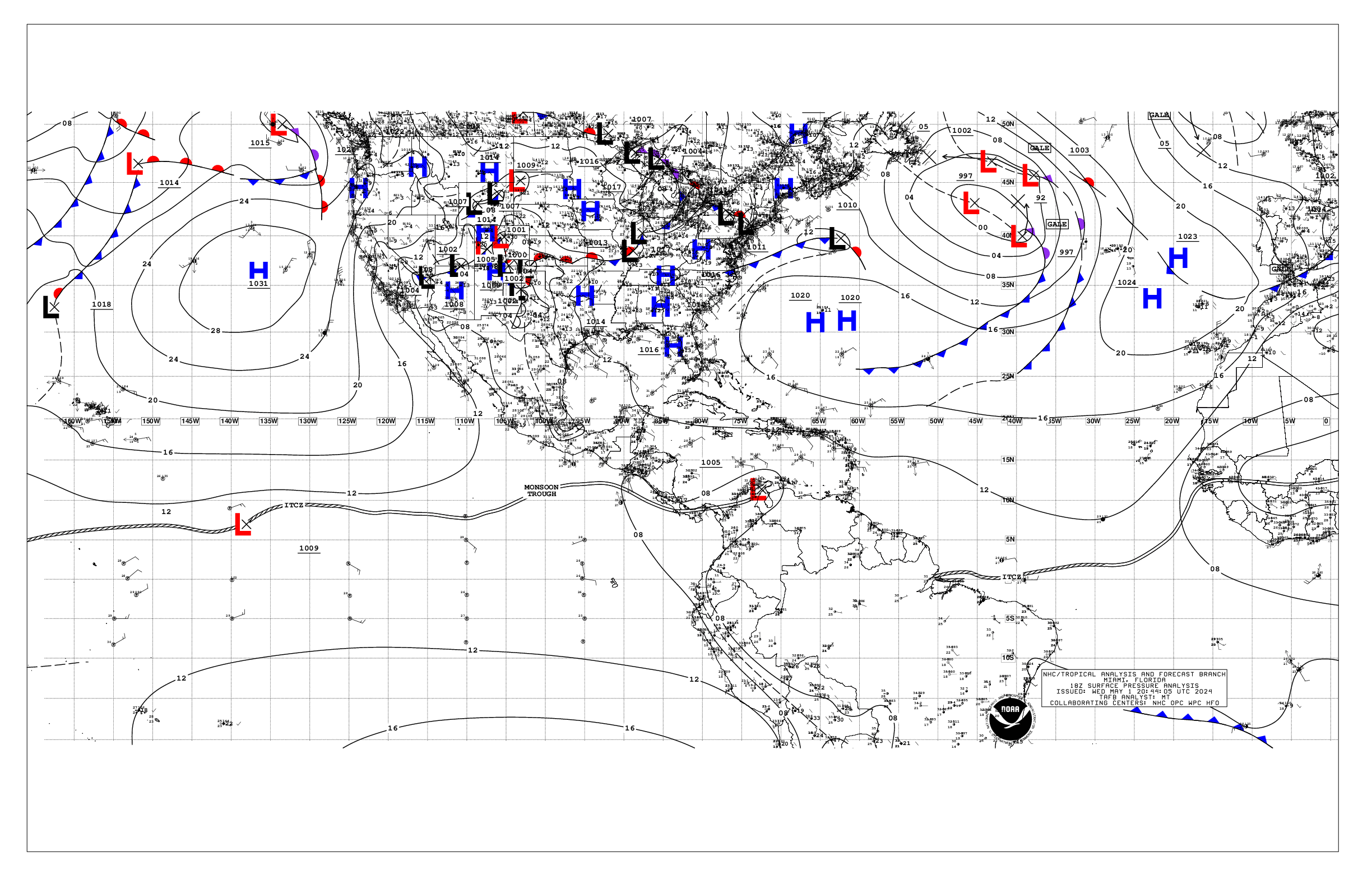
Based on 1800 UTC surface analysis and satellite imagery through
2100 UTC.

...SPECIAL FEATURES...

Significant Large NW Swell: Large NW swell continues to move
southeastward across the NW and north-central waters this
afternoon, behind and just ahead of a cold front that extends
from the central Gulf of California to 26N111W to 22N113W, then
it becomes stationary to 16N124W. Seas of 8 to 13 ft cover the
waters N of 24.5N and W of 119W. Seas will continue to subside
to less than 12 ft this evening. A new N swell enters the
northern waters by early Wed, raising seas above 12 ft across the
waters N of 26N between 117W and 140W by Wed evening, and
spreading southward into early Thu before slowly subsiding to
less than 12 ft Thu. Looking ahead, another significant and large
NW swell event is possible in the NW waters late in the upcoming
weekend into early next week. Please refer to the latest NWS
High Seas Forecast at website:
https://www.nhc.noaa.gov/text/MIAHSFEP2.shtml for more details.

...INTERTROPICAL CONVERGENCE ZONE/MONSOON TROUGH...

A trough extends from 07.5N82W to 04.5N90W. The ITCZ extends
from 04.5N90W to 00N120W to beyond 03N140W. Scattered moderate
convection is noted from 02S to 04N between 103W and 110W.

...OFFSHORE WATERS WITHIN 250 NM OF MEXICO...

A cold front extends from the central Gulf of California to
26N111W to 22N113W, then it becomes stationary to 16N124W. Fresh
to locally strong SW winds are in the central Gulf of California
ahead of the front, with moderate NW winds behind the front
offshore Baja California Norte N of 31N. A gale warning is in
place just N of 30N in the San Diego coastal waters tonight.
Building seas in rough to very rough NW swell are arriving behind
the front. Moderate to fresh N gap winds prevail over the Gulf
of Tehuantepec per recent ASCAT scatterometer data. Winds are
moderate or weaker across the remainder of the waters with
moderate seas, except locally fresh winds near Cabo Corrientes,
and slight seas in the central and southern Gulf of California.

For the forecast, the cold front from the far central Gulf of
California to off Baja California will gradually dissipate
through tonight. Fresh to locally strong S to SW winds ahead of
the front and in the northern Gulf of California will persist
through late this afternoon. High pressure will build in across
the area waters in the wake of the front through Fri, producing
fresh to locally strong northerly winds nearshore Baja California
to near Cabo Corrientes Wed through Thu night. Strong to near
gale- force SW to W winds will develop again across the northern
Gulf of California early Wed through Wed evening, then again Thu
night into early Fri due to localized troughing. NW swell will
continue to build across the waters of Baja California through
Wed, then become reinforced Wed night through the end of the
week, decaying during the upcoming weekend. Looking ahead, long
range model guidance indicates the potential for at least a
strong gale-force northerly gap wind event in the Gulf of
Tehuantepec late in the upcoming weekend into early next week,
although uncertainty exists being so far out in time. Please stay
tuned as we get closer to this next potential event.

....OFFSHORE WATERS WITHIN 250 NM OF CENTRAL AMERICA, COLOMBIA,
AND WITHIN 750 NM OF ECUADOR...

Fresh to locally strong NE to E offshore winds prevail across
the Papagayo region according to the latest ASCAT, along with 4
to 7 ft seas. Moderate to locally fresh northerly winds are
occurring across the Gulf of Panama and veer NE and pass south of
the Azuero Peninsula. Winds are light to gentle elsewhere. Seas
are mainly 2 to 4 ft elsewhere, locally to 5 ft.

For the forecast, fresh to strong NE to E gap winds and moderate
seas will pulse across the Papagayo region as high pressure
builds across Central America from the north, continuing through
early Thu, then become moderate to fresh thereafter. Moderate N
to NE winds will pulse to locally fresh from the Gulf of Panama
to south of the Azuero Peninsula through Wed. Elsewhere,
moderate or weaker winds and slight to moderate seas will change
little through the next several days.

...REMAINDER OF THE AREA...

Please refer to the Special Features section for more details on
significant NW swell forecast for the northern waters.

A cold front extends from the central Gulf of California to
26N111W to 22N113W, then it becomes stationary to 16N124W.
Fresh to strong NE trades are found from 08.5N to 22N between
121W and 140W. Winds are mainly moderate or weaker across the
remainder of the open waters. Rough seas are W of a line from
29N115W to 20N121W to 09N140W with very rough seas as described
above. Seas are moderate elsewhere. Numerous moderate to isolated
strong convection is depicted from 06N to 15.5N between 132W and
140W in association to a surface and an upper level trough.

For the forecast, the cold front will continue to move eastward
this afternoon while weakening. High pressure will build in the
wake of the front this afternoon through Fri as a low to middle-
level disturbance develops S of 20N and near 140W. This scenario
will produce a broad area of fresh to near gale-force trades N of
the ITCZ to near 24N and W of 130W tonight through early Fri,
along with rough to very rough seas. Expect active showers and
thunderstorms, with rough to very rough seas in NW swell to
accompany these increasing trades. Marine conditions should
improve by the end of the week and into the weekend as the
disturbance dissipates and the pressure gradient weakens.

$$
KRV


 NHC on Facebook
 NHC on X
 NHC on YouTube
 NHC Blog: