000
AXNT20 KNHC 060942
TWDAT

Tropical Weather Discussion
NWS National Hurricane Center Miami FL
1215 UTC Mon Jul 6 2026

Tropical Weather Discussion for North America, Central America
Gulf of America, Caribbean Sea, northern sections of South
America, and Atlantic Ocean to the African coast from the
Equator to 31N. The following information is based on satellite
imagery, weather observations, radar and meteorological analysis.

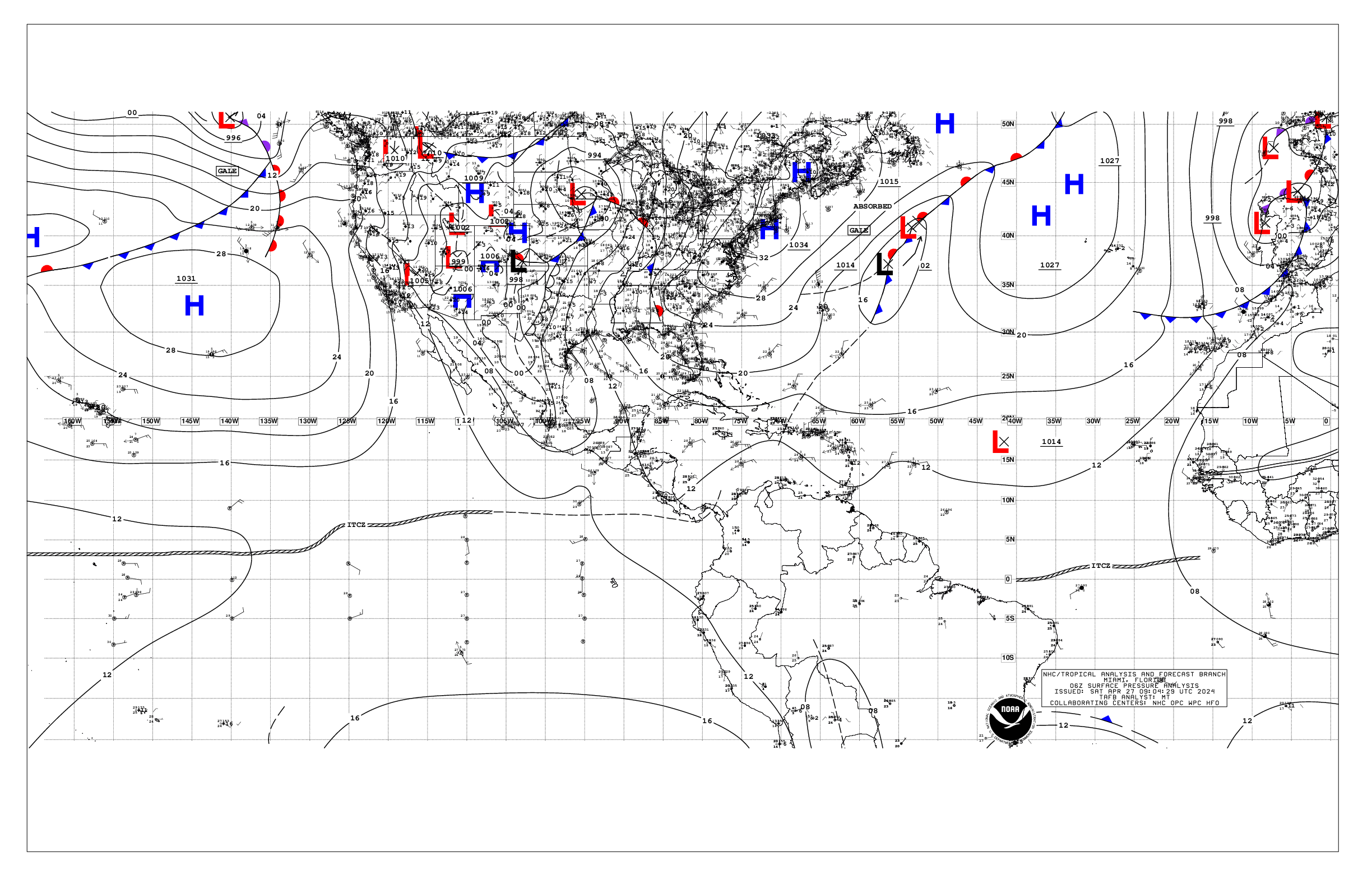
Based on 0600 UTC surface analysis and satellite imagery through
0930 UTC.

...TROPICAL WAVES...

A tropical wave is along 33W S of 17N, moving W at 10 to 15 kt.
Convection is described in the Monsoon Trough/ITCZ section below.

An Atlantic tropical wave is near 41W and S of 18N, moving W at
10 to 15 kt. Convection is described in the Monsoon Trough/ITCZ
section below.

An Atlantic tropical wave is near 50W south of 19N, moving W at
around 15 kt. Convection is described in the Monsoon Trough/ITCZ
section below.

A Caribbean tropical wave is near 79W, south of 19N, moving W at
at 10-15 kt. Scattered moderate convection is active from 09N to
20N between 80W and 87W.

...MONSOON TROUGH/ITCZ...

The monsoon trough enters the Atlantic near 20N16W to 10N20W.
Segments of the ITCZ extend from 10N22W to 08N32W, from 06N33W to
06N40W, from 07N42W to 07N50W, and from 07N52W to 06N57W.
Scattered moderate convection is noted within 240 nm on either
side of the ITCZ and west of 25W.

...GULF OF AMERICA...

The subtropical ridge extends across the Florida Peninsula and
across the northern Gulf to the coast of Texas. A surface trough
reaches from Mobile Bay, Alabama to Tampa, Florida. Scattered showers and
thunderstorms are active off the western Florida Panhandle along
this trough. Scattered showers and thunderstorms are also active over the
southeast Gulf, under divergent flow aloft. Farther south, a weak
trough is positioned over the Bay of Campeche. This pattern is
supporting fresh NE winds off the west coast of the Yucatan
Peninsula, as noted in a recent scatterometer satellite pass.
Gentle to moderate breezes are observed elsewhere. Seas are
generally 1-3 ft across the basin.

For the forecast, surface ridging is forecast to prevail across the
basin through the forecast period, thus supporting gentle to
moderate winds over the western half of the Gulf, except for
locally fresh to strong ENE winds offshore the Yucatan peninsula
at night. Locally moderate or weaker winds are forecast for the
eastern half of the Gulf while mainly slight seas are forecast
basin-wide.

...CARIBBEAN SEA...

The subtropical ridge extending north of the area across the
western Atlantic is supporting moderate to fresh trade winds
across the eastern and central Caribbean, with strong E winds
noted off northeast Colombia and northwest Venezuela. Seas are
7-10 ft over the south-central Caribbean in the area of strongest
trade winds, and 6-7 ft elsewhere east of 80W. A recent
scatterometer satellite pass indicated fresh to strong easterly
winds across the Gulf of Honduras, likely related to scattered
showers and a few thunderstorms active in that area, associated
with divergent flow aloft on the east side of an upper low
centered over the Yucatan Peninsula. Seas across the Gulf of
Honduras are 4-6 ft, and 2-4 ft elsewhere over the northwest
Caribbean.

For the forecast, the pressure gradient between the Atlantic ridge
north of the basin and the Colombian Low will continue to
support fresh to strong trade winds and moderate to rough seas
over the central Caribbean through the weekend. The aerial
extent of these winds will continue to increase today as the
Atlantic ridge continues to build westward. By Wed, the fresh to
strong winds are expected to extend across most of the east,
central and SW Caribbean. Expect winds to reach near-gale force at
night offshore of Colombia and in the Gulf of Venezuela through
Fri. Moderate or weaker winds will prevail over the NW part of the
basin, except in the Gulf of Honduras where fresh to locally
strong E to SE winds are forecast at night through the forecast
period.

...ATLANTIC OCEAN...

The Atlantic subtropical ridge dominates the Atlantic north of
20N, and is anchored by 1025 mb high pressure centered near
29N39W. The pattern is supporting gentle to moderate breezes and
3-5 ft seas along and west of the ridge axis, and moderate to
fresh NE to E trade winds and 5-7 ft seas east and south of the
ridge axis. Upper divergent flow is supporting a few showers and
thunderstorms from 25N to 30N 45W and 70W.

For the forecast west of 55W, the Atlantic subtropical ridge will stay
in place through the forecast period, developing a center of high
pressure E of the Bahamas by Fri. This pattern will continue to
support moderate to fresh E to SE trade winds S of 23N, and
moderate or weaker winds elsewhere. Locally strong winds, with
moderate to rough seas are expected at night north of Hispaniola,
including approaches to the Windward Passage, through Fri night.

$$
Christensen


 NHC on Facebook
 NHC on X
 NHC on YouTube
 NHC Blog: