049
AXNT20 KNHC 011013
TWDAT

Tropical Weather Discussion
NWS National Hurricane Center Miami FL
1215 UTC Mon Jun 1 2026

Tropical Weather Discussion for North America, Central America
Gulf of America, Caribbean Sea, northern sections of South
America, and Atlantic Ocean to the African coast from the
Equator to 31N. The following information is based on satellite
imagery, weather observations, radar and meteorological analysis.

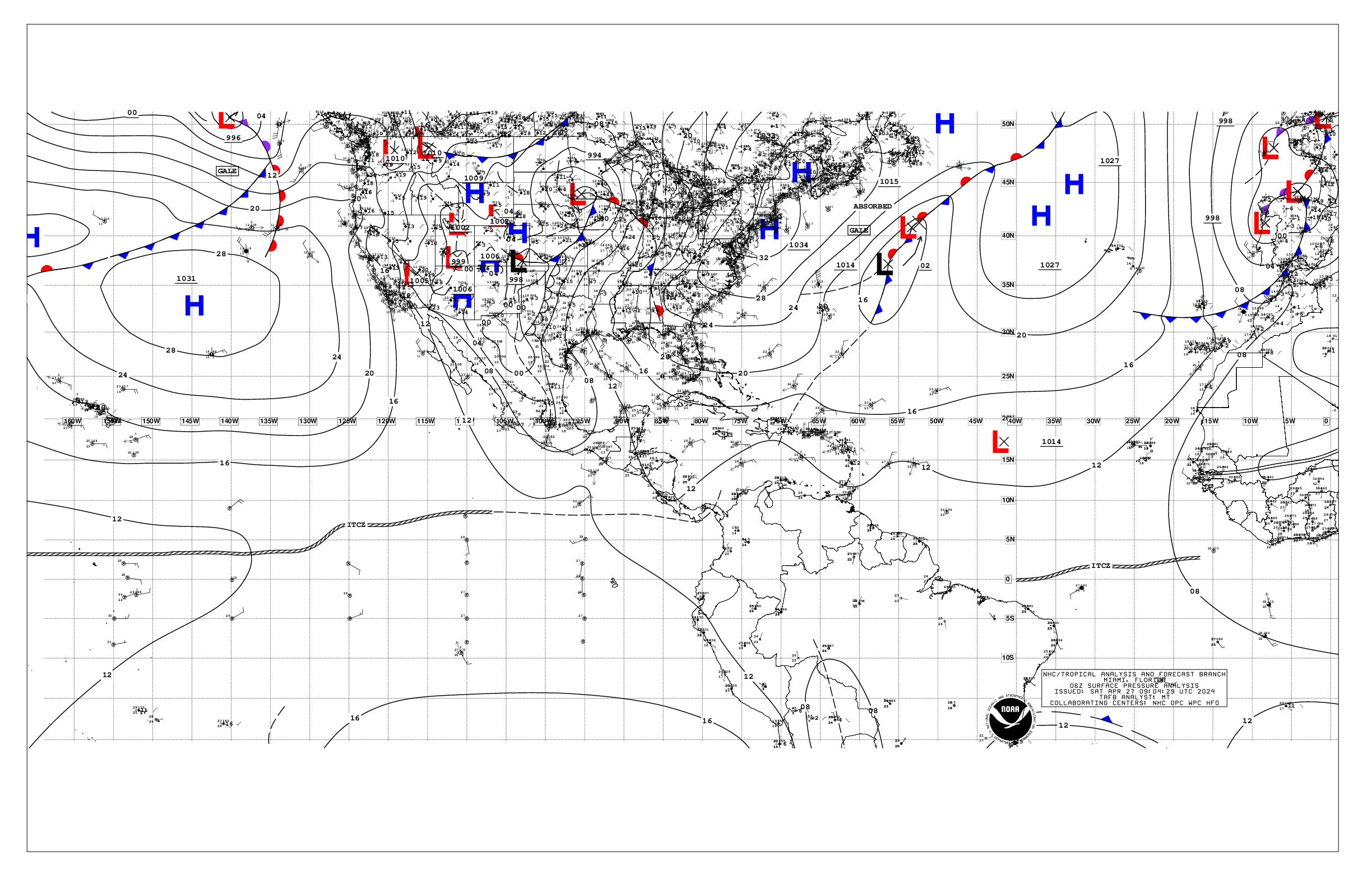
Based on 0600 UTC surface analysis and satellite imagery through
1000 UTC.

...SPECIAL FEATURES...

Atlantic Gale Warning: 1014 mb low pressure off the Georgia coast will
deepen as it moves eastward toward Bermuda through late Tue, dragging
a cold front that move toward the northern Bahamas. Expect strong
SW winds ahead of the low pressure and front Tue, with near gale
to gale-force winds and rough to very rough seas southeast of
Bermuda by late Tue. Winds diminish below gale-force Tue night as
the front stalls from Bermuda to the northern Bahamas Tue,
although fresh to strong winds and rough seas will persist within
300 nm east of the front north of 27N through mid week.

Please read the latest High Seas and Offshore Waters Forecast
issued by the National Hurricane Center at websites -
https://www.nhc.noaa.gov/text/MIAHSFAT2.shtml and
https://www.nhc.noaa.gov/marine/offshores.php for more details.

...TROPICAL WAVES...

An eastern Atlantic tropical wave is along 32W, south of 12N and
moving westward at 10 to 15 kt. Convection is described in the
monsoon trough/ITCZ section below.

A central Caribbean tropical wave is along 73W, south of 17N and
moving westward at 10 to 15 kt. Relatively dry air over the basin
is precluding convection near this wave at this time.

A western Caribbean tropical wave is along the coast of Nicaragua
near 83W, south of 15N and moving westward at around 15 kt.
Scattered moderate convection extends from western Panama to
southeast Nicaragua.

...MONSOON TROUGH/ITCZ...

The monsoon trough enters the Atlantic through the coast of
Senegal near 14N17W, then curves southwestward to 08N25W then on
to 05N40W. The ITCZ extends from 05N40W to 05N52W. Scattered
moderate convection is evident from 04N to 08N between 30W and 40W.

...GULF OF AMERICA...

Instability under the center of an upper level low is supporting
numerous thunderstorms this morning over the far southwest Gulf
along the coast of Veracruz state in Mexico. Thunderstorms are
also active over the Loop Current north of the Yucatan Channel and
over the northeast Gulf 120 nm off the western Florida Panhandle
associated with the lift provided by the right rear entrance area
of an upper jet over the southeast U.S. 1018 mb high pressure
cell is centered over the eastern Gulf near 26N84W. This pattern
is supporting gentle breezes and 1-3 ft seas over the eastern
Gulf, with moderate SE winds and 2-4 ft over the western Gulf.

For the forecast, the ridge will continue to dominate the Gulf
waters into midweek supporting gentle to moderate E to SE winds
with moderate seas. The exception will be evening pulses of fresh
winds off the northern Yucatan Peninsula and in the central Gulf
through the same period. An upper-level trough across the western
Gulf will continue to support showers and thunderstorms across the
east and central Gulf through mid week. Expect fresh to strong E
winds and moderate to rough seas across the NE Gulf Wed and Wed
night as a frontal boundary reaches the area. Looking ahead, these
winds and seas will diminish Thu through Fri as the front stalls
and weakens from the southeast Gulf to the north-central Gulf.

...CARIBBEAN SEA...

The tight pressure gradient between the subtropical ridge
northeast of the islands and lower pressures in northern Colombia
results in fresh to strong easterly trade winds and seas of 5-8
ft across the central Caribbean. Fresh to locally strong easterly
breezes and moderate seas are found in the Gulf of Honduras.
Moderate to fresh easterly breezes and moderate seas are noted in
the eastern and remainder of the NW Caribbean. Elsewhere, light to
gentle winds and slight to moderate seas are prevalent.

For the forecast, the Atlantic ridge combined with the Colombian low
will support moderate to fresh trade winds across most of the
basin, with fresh to strong winds and rough seas over the south-
central Caribbean. The area of fresh to strong winds and rough
seas will expand across the east and central Caribbean tonight
into Tue as the ridge north of the area strengthens. Looking
ahead, winds and seas will diminish slightly starting late Wed as
the ridge north of the basin weakens. Farther west, strong winds
will pulse across the Gulf of Honduras mainly at night through
Fri.

...ATLANTIC OCEAN...

Please read the Special Features section about a Gale Warning for
waters southeast of Bermuda Tue.

A cold front extends from 31N59W to the central Bahamas. Scattered
showers and thunderstorms are active along with fresh to strong
SW winds and 8-10 ft seas within 90 nm east of the front, north of
27N. 1019 mb high pressure is centered off the Carolinas near
33N71W, east of 1014 mb low pressure centered off Georgia. This
pattern is supporting moderate to fresh SE winds and 5-6 ft seas
north of 30N and southeast of the low pressure. Gentle NE breezes
are noted elsewhere west of the front. Combined seas are 5-8 ft in
NW swell north of 27N and 3-5 ft elsewhere west of 60W. Farther
east, a broad ridge extends from 1019 mb high pressure centered
southwest of the Azores, southwestward to Hispaniola. This pattern
is supporting fresh to strong NW winds and 6-9 ft seas south of
the ridge axis, and gentle to moderate breezes with 4-6 ft seas
along the ridge axis. A large area of Saharan dust covers most of
the Atlantic between 10N and 20N, east of 60W.

For the forecast west of 55W, the cold front will shift
southeastward, ahead of a low pressure area and attendant front moving
off the Georgia coast. The low pressure will move toward Bermuda
through late Tue, with a trailing cold front reaching as far south
as the northern Bahamas. Expect strong SW winds ahead of the low
pressure and front Tue, with near gale to gale-force winds and
rough to very rough seas expected southeast of Bermuda by late
Tue. The front will stall from Bermuda to the northern Bahamas Tue
night, ahead of a reinforcing front moving into the waters off
northeast Florida accompanied by strong to near- gale force winds
and rough seas. Looking ahead, winds and seas will diminish into
Fri after the fronts merge, then weaken in place from Bermuda to
the northern Bahamas with broad high pressure building off the
Carolinas. Farther south, strong winds may pulse off the northern
coast of Hispaniola Tue night.

$$
Christensen


 NHC on Facebook
 NHC on X
 NHC on YouTube
 NHC Blog: