000
AXNT20 KNHC 261018
TWDAT

Tropical Weather Discussion
NWS National Hurricane Center Miami FL
1215 UTC Wed Aug 26 2026

Tropical Weather Discussion for North America, Central America
Gulf of America, Caribbean Sea, northern sections of South
America, and Atlantic Ocean to the African coast from the
Equator to 31N. The following information is based on satellite
imagery, weather observations, radar and meteorological analysis.

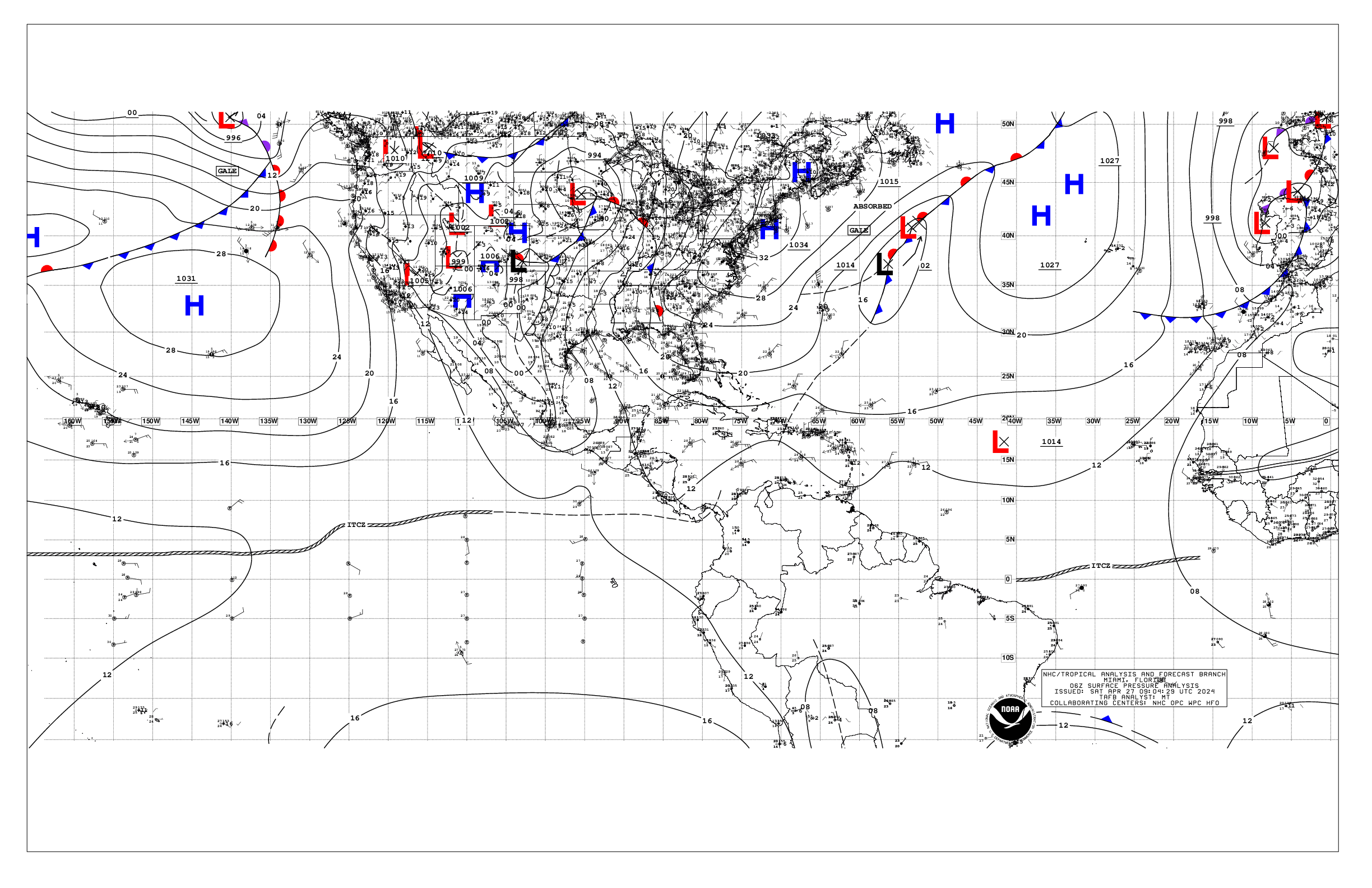
Based on 0600 UTC surface analysis and satellite imagery through
0955 UTC.

...SPECIAL FEATURES...

Eastern Tropical Atlantic (Invest AL96): An area of low pressure
associated with a tropical wave, located a few hundred miles
south-southwest of the Cabo Verde Islands, is producing showers
and thunderstorms that are displaced to the southwest of its
center. Environmental conditions remain somewhat favorable for
development over the next couple of days, and a tropical
depression is likely to form over the next day or two as the
system moves westward to west-northwestward across the eastern and
central tropical Atlantic. Environmental conditions are forecast
to become less favorable by this weekend, potentially ending its
chances for development. Formation chance through 48 hours and 7
days is high.

Please refer to the latest NHC Tropical Weather Outlook at website:
https://www.hurricanes.gov/text/MIATWOAT.shtml for more details on
this feature.

Caribbean Gale Warning: Tight pressure gradient between the
subtropical ridge centered north of the Caribbean Sea and lower
pressures in northern Colombia will support fresh to strong
easterly trade winds and rough seas through the forecast period.
Winds will pulse to gale-force tonight and Thu night off Colombia
and in the Gulf of Venezuela, along with locally very rough seas.

Please refer to the latest HIGH SEAS FORECAST issued
by the National Hurricane Center at website -
https://www.nhc.noaa.gov/text/MIAHSFAT2.shtml for more details.

...TROPICAL WAVES...

A central Atlantic tropical wave is along 57W, south of 21N,
moving westward at 10 to 15 kt. No significant deep convection is
occurring in association with this wave.

A central Caribbean Sea tropical wave is along 72W, south of 20N,
moving westward at 10 to 15 kt. No convection is observed with
this wave.

For information on the tropical wave previously described in the
western Caribbean, please read the Eastern Pacific Tropical
Weather Discussion.

...MONSOON TROUGH/ITCZ...

The monsoon trough extends from the coast of Senegal near 21N16W
to 13N43W. The ITCZ continues from 13N43W to 11N55W. Scattered
moderate to isolated strong convection is occurring from 05N to
18N and east of 19W.

...GULF OF AMERICA...

A few showers are noted in the Florida Straits, while generally
dry conditions are present in the remainder of the Gulf waters. A
weak high pressure system over the central Gulf maintains moderate
or weaker winds and slight seas across much of the basin.

For the forecast, a weak pressure pattern will persist across the Gulf
waters through the forecast period, supporting moderate or weaker
winds and slight seas. Winds will pulse to fresh to locally strong
with moderate seas off western Yucatan during the evenings due
to a diurnal surface trough moving west off the peninsula each
night. Scattered showers and isolated thunderstorms may increase
across the northern Gulf waters late this week into the weekend as
an upper level trough passes to the north.

...CARIBBEAN SEA...

Please see the Special Features section for details on the Gale
Warning in effect for the waters off Colombia and in the Gulf of
Venezuela.

Divergence aloft and tropical moisture combine to produce
scattered showers and isolated thunderstorms across the NW
Caribbean and off Nicaragua, Costa Rica and Panama. Dry conditions
prevail elsewhere. Outside of the Gale Warning area, fresh to
strong easterly trade winds and moderate seas are noted in the
north-central and SW Caribbean. Moderate or weaker winds and
slight to moderate seas are prevalent in the rest of the basin.

For the forecast, a tight pressure gradient between the subtropical
ridge north of the islands and lower pressures in northern
Colombia will support fresh to strong easterly trade winds and
rough seas through the forecast period. Winds will pulse to gale-
force tonight and Thu night off Colombia and in the Gulf of
Venezuela, along with locally very rough seas. Meanwhile, winds
will pulse to fresh to locally strong in the Windward Passage at
night. Looking ahead, an area of low pressure, Invest AL96,
currently located in the eastern Atlantic, has a high chance of
tropical development over the next 7 days. The system may bring
increasing winds and seas to portions of the Tropical N Atlantic
this weekend.

...ATLANTIC OCEAN...

Please refer to the Special Features section for more details on
an area of low pressure, Invest AL96, that has a high chance of
development.

Divergence aloft supports scattered showers and isolated
thunderstorms west of 75W, affecting the Florida coast and NW
Bahamas. Farther east, a weak surface trough along 59W is
producing scattered showers between 55W and 60W and north of 24N.
The rest of the basin is dominated by a broad subtropical ridge.
Moderate to locally fresh easterly winds and seas of 4-8 ft are
noted east of 60W. Meanwhile, moderate or lighter winds and slight
to moderate seas are found west of 60W. However, gusty winds and
higher seas are likely near the stronger storms.

For the forecast west of 55W, an elongated trough extending from
north of the area southward to 27N along 59W will continue to
support scattered showers and isolated thunderstorms through
today. The subtropical ridge will dominate the remainder of the SW
N Atlantic waters through the next several days, supporting
mainly moderate or weaker winds and slight to moderate seas. Winds
will pulse to fresh to locally strong off northern Hispaniola at
night. Looking ahead, an area of low pressure, Invest AL96,
currently located in the eastern Atlantic, has a high chance of
tropical development over the next 7 days. The system may bring
increasing winds and seas to portions of the southeast waters this
weekend.

$$
Delgado


 NHC on Facebook
 NHC on X
 NHC on YouTube
 NHC Blog: