000
AXNT20 KNHC 292256 CCA
TWDAT

Tropical Weather Discussion
NWS National Hurricane Center Miami FL
0015 UTC Mon Mar 29 2026

Tropical Weather Discussion for North America, Central America
Gulf of America, Caribbean Sea, northern sections of South
America, and Atlantic Ocean to the African coast from the
Equator to 31N. The following information is based on satellite
imagery, weather observations, radar and meteorological analysis.

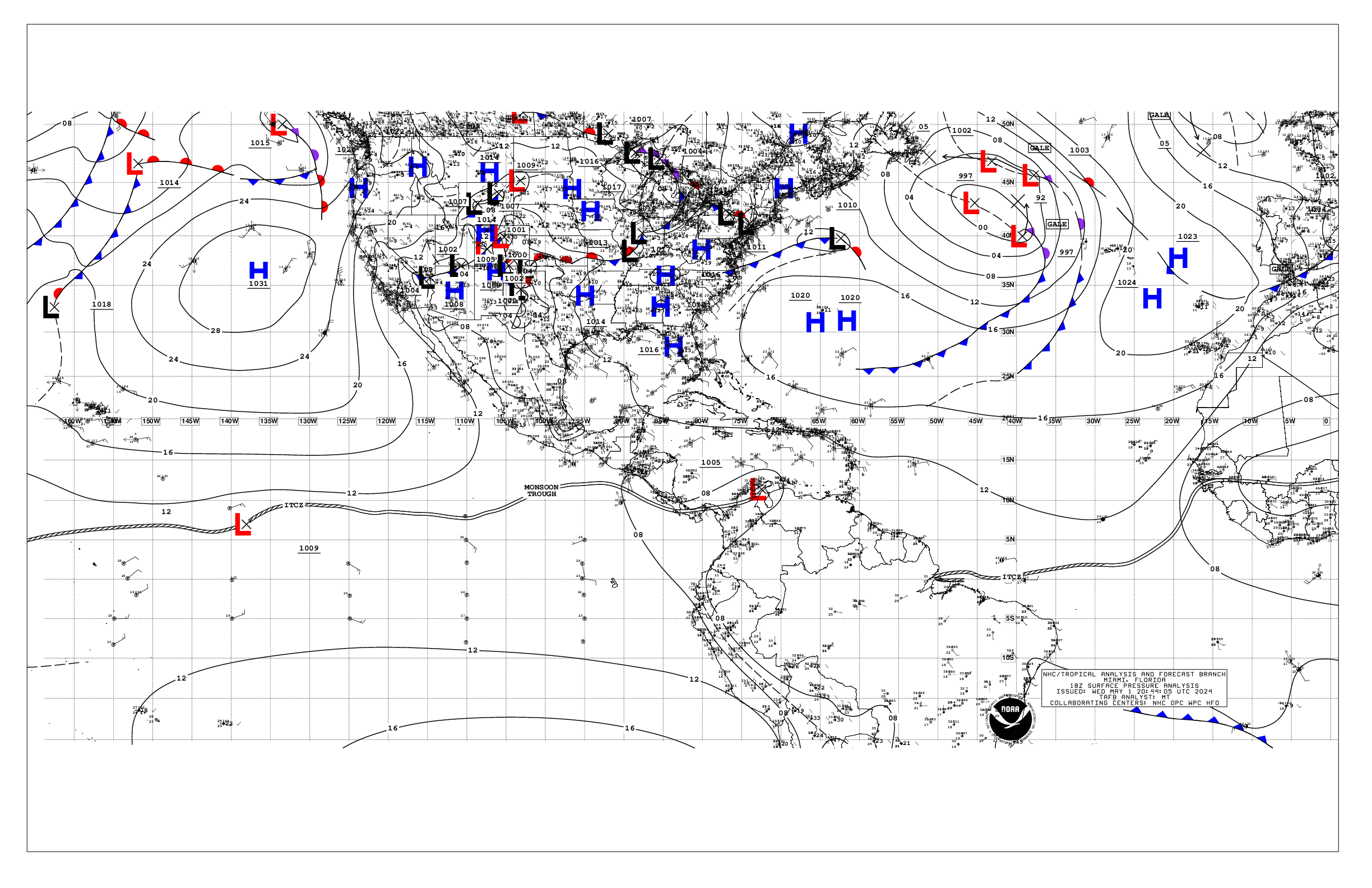
Based on 1800 UTC surface analysis and satellite imagery through
2230 UTC.

...SPECIAL FEATURES...

Atlantic Ocean High Seas Event: Rough to very rough seas in mixed
N to NE swell continue across all the Atlantic waters south of
31N and east of 80W this evening, along and to the north of strong
cold front that extends from 31N60W to the Florida Keys at 1800 UTC.
Recent altimeter and buoy data show seas of at least 12 to 16 ft,
in a broad spectrum of wave periods from 7 to 10 seconds, with
peak seas likely around 18 ft. These seas are begin generated by a
broad wind field moving southeastward with the cold front, and will
continue to propagate and cover most of the waters N of 25N and W
of 55W to the Bahamas by tonight. The cold front will reach from
31N50W to Hispaniola by Mon morning. At that time, seas of 12 to
16 ft are expected behind the front. Rough to very rough seas will
continue to affect most of central and western Atlantic waters N
of 2ON through Tue morning. Seas are forecast to subside below 12
ft by Wed night.

Please, refer to the latest NWS High Seas Forecast, that is
issued by the National Hurricane Center, at the website:
https://www.nhc.noaa.gov/text/MIAHSFAT2.shtml, for more details.

Gale Warning E of 35W: Meteo-France has issued a Gale Warning for
the forecast zone of Agadir near the coast of W Africa. The forecast
calls for northeast gales to 40 kt, with severe gusts, from 29/18
UTC to 30/12 UTC at least. Seas are forecast to build to 15 or 16
ft with these winds by Mon morning.

For more details, refer to the Meteo- France High Seas Forecast
listed on their website https://wwmiws.wmo.int

...MONSOON TROUGH/ITCZ...

The monsoon trough enters the Atlantic from the coast of Liberia
near 06N10W and continues westward to 02.5N17W. The ITCZ then
extends from that point to the coast of Brazil at 03S39W.
Scattered moderate to isolated strong convection is noted from 00N
to 05N between 03W and 28W. Similar convective activity is S of
01N between 28W and 50W.

...GULF OF AMERICA...

A cold front across the basin today is becoming ill defined as it
stretches from the Florida Keys to the central Gulf near 26N89W.
Scattered moderate convection is along and north of the front
over central portions. Moderate to fresh NE to E winds and
moderate to rough seas prevail north of the front over the NE Gulf
basin E of 90W. Moderate NE winds are ongoing in the E Bay of
Campeche with seas 4 to 5 ft. Elsewhere winds are moderate or
weaker, becoming SE winds across NW portions of the Gulf, with
slight to moderate seas prevailing.

For the forecast, the cold front over the SE Gulf will stall and
dissipate early this week. High pressure will build in the wake
of the front. Moderate to fresh E to SE winds and moderate seas
will prevail over the E Gulf through Fri night. Moderate to
locally fresh SE winds are forecast for the western half of the
Gulf.

...CARIBBEAN SEA...

The pressure gradient between strong high pressure building north
of the Atlantic cold front and the Colombian low is supporting
fresh to strong NE to E winds offshore Colombia, where seas are 6
to 8 ft. Winds of similar speed are ongoing through the Windward
Passage, in the lee of Cuba and south of Hispaniola, where seas
are 5 to 7 ft. Elsewhere, moderate or weaker winds prevail. Low-
topped trade wind showers are moving westward across the basin,
with showers more concentrated across the western basin.

For the forecast, the pressure gradient between high pressure N
of the area and the Colombian low will support fresh to strong
winds and rough seas offshore Colombia through midweek, pulsing to
near gale force at night. Fresh winds will then pulse to strong
there at night through Fri night. This pressure gradient will
also support fresh to strong NE winds in the lee side of Cuba, the
Windward Passage, and south of Hispaniola through Thu.

...ATLANTIC OCEAN...

A strong cold front extends from 31N60W through the NW Bahamas and
across the Florida Keys. Strong to near-gale force NE to E winds,
and rough to very rough seas dominate the entire area N of the
front. See details on these conditions in the Special Features
section. Scattered to locally numerous showers are along and
within 150 nm N of the front. Farther E, a surface trough is
analyzed and extends 31N56W to 21N57W. A weak 1017 mb low
pressure is along the trough near 28N56W. An area of showers,
with isolated thunderstorms, is east of the trough axis, covering
the waters N of 20N between 46W and the trough. The remainder of
the Atlantic forecast region is under the influence of a strong
1042 mb high pressure located NE of the Azores. The associated
ridge extends SW to near 50W. This system tightens the pressure
gradient across the area and supports fresh to strong NE to E
winds and moderate to rough seas in NE swell extending from the
NW coast of Africa to about 30W, including the Madeiras and Canary
Islands. Moderate or weaker winds and moderate seas are elsewhere.

For the forecast west of 55W, the above mentioned cold front will
reach from 31N50W to Hispaniola by Mon morning before dissipating
over the SE waters on Tue. Strong to near-gale force NE to E
winds will continue to generate rough to very rough seas N of the
front. Strong high pressure will build in the wake of the front.
Due to this strong high pressure, fresh to strong NE to E winds
and rough to very rough seas are expected across most of the
offshore forecast waters through the end of the week.

$$
Stripling


 NHC on Facebook
 NHC on X
 NHC on YouTube
 NHC Blog: