000
AXNT20 KNHC 220841
TWDAT

Tropical Weather Discussion
NWS National Hurricane Center Miami FL
1215 UTC Tue Sep 22 2026

Tropical Weather Discussion for North America, Central America
Gulf of America, Caribbean Sea, northern sections of South
America, and Atlantic Ocean to the African coast from the
Equator to 31N. The following information is based on satellite
imagery, weather observations, radar and meteorological analysis.

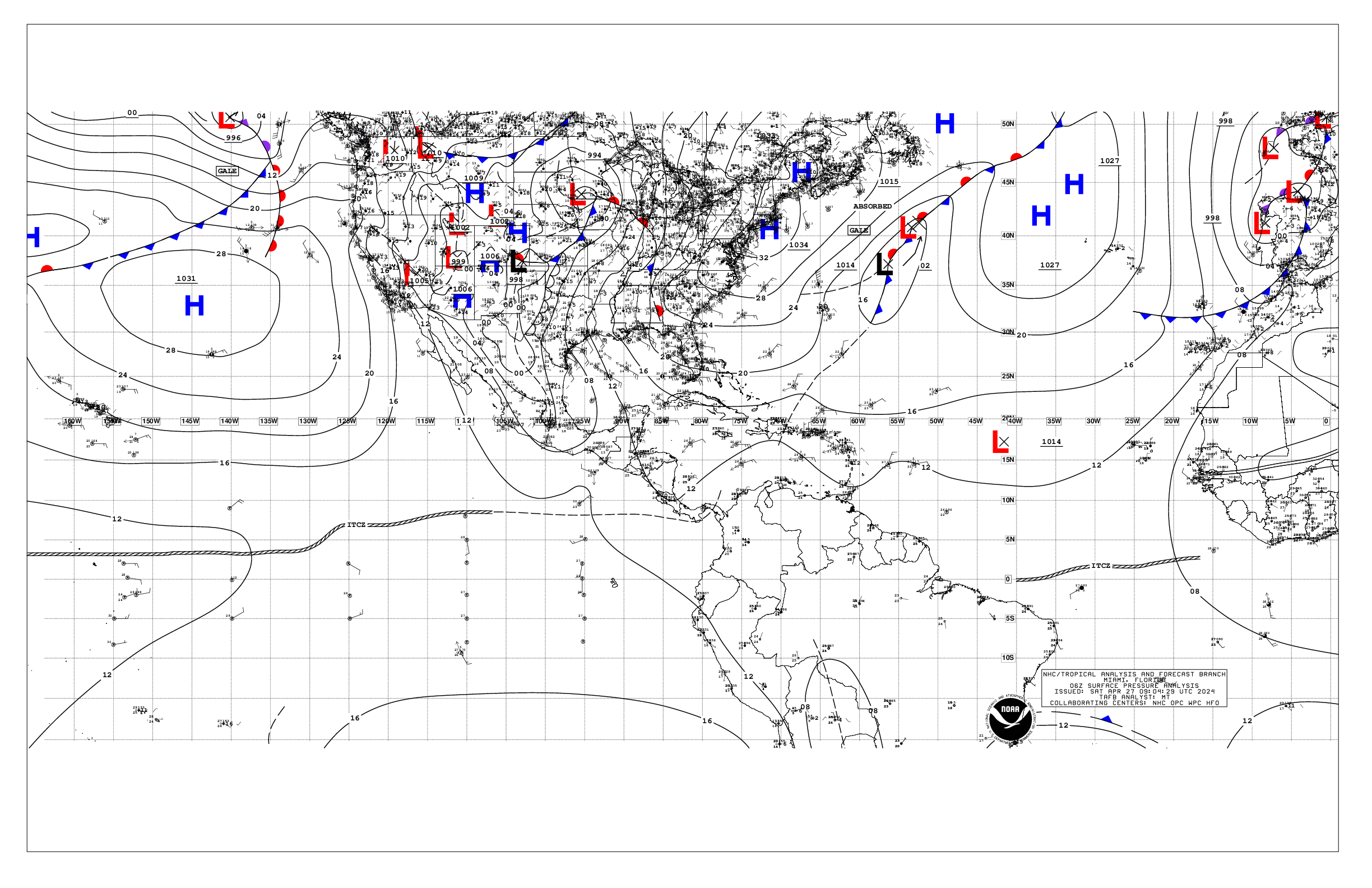
Based on 0600 UTC surface analysis and satellite imagery through
0840 UTC.

...SPECIAL FEATURES...

Heavy Rainfall in Central America, Jamaica, and Cuba: A mid to
upper- level trough currently extends over the NW Caribbean while
relatively warm sea surface temperatures are present, and in
addition there is a potential for a Central American Gyre to form
during the next several days. All of these factors are expected to
lead to enhanced moisture funneling into Central America and the
Caribbean to support heavy rainfall from September 22nd through
the 25th. There is still some uncertainty regarding the exact
location of heaviest rainfall, but for now heavy rainfall looks
likely across portions of Costa Rica and Panama, as well as across
southern Guatemala, far western Honduras, and far northern El
Salvador. Currently, heavy rainfall is ongoing over western
Jamaica and into central and eastern Cuba. Heavy rainfall in these
regions will raise concerns for life- threatening flash flooding
and landslides. Please refer to local weather services as well as
the International Desk at the Weather Prediction Center for more
information.

...TROPICAL WAVES...

An eastern Atlantic tropical wave has its axis near 33W/34w from
05N to 19N, moving westward at 10 to 15 kt. No significant
convection is noted with this wave.

A central Atlantic tropical wave is analyzed from 21N47W to
07N51W, moving westward at 10 to 15 kt. Scattered to numerous
showers and thunderstorms are active on the northern end of this
tropical wave from 19N to 22N between 45W and 47W.

...MONSOON TROUGH/ITCZ...

The monsoon trough axis extends from the coast of Africa near
13N16W southwestward to 11N25W. Segments of the ITCZ axis extend
from 11N25W to 10N33W, from 10N35W to 07N49W, and from 07N51W to
06N57W. Scattered moderate convection is noted from 10N to 15N
between 18W and 23W.

...GULF OF AMERICA...

A very weak pressure gradient, anchored by 1015 mb high pressure
over south-central Louisiana, prevails across the area generating
light to gentle winds and slight seas across the Gulf. An upper-
level trough over the eastern Gulf is supporting scattered showers
and isolated thunderstorms over the Florida Straits. A few
showers and thunderstorms the coast of Louisiana.

For the forecast, a very weak pressure gradient will force gentle to
moderate winds across the Gulf through Thu. A vigorous upper-
level low will promote scattered showers and thunderstorms over
the SE Gulf and the Straits of Florida for at least the next two
days. A cold front should dip into the NE Gulf Thu night and
Fri, accompanied with little to no increase in the winds.

...CARIBBEAN SEA...

As described above in the Special Features section, large areas
of showers and thunderstorms continue to move north of Jamaica
and into western and central Cuba. This activity is due to
abundant tropical moisture and divergent flow aloft on the
southeast side of an upper trough extending from eastern Gulf to
the Yucatan Channel. Isolated pockets of showers and thunderstorms
are noted elsewhere across the western Caribbean. Outside of
convection, a weak pressure pattern is across the basin. Moderate
to fresh trades along with moderate seas remain east of 80W. Light
to gentle winds and slight to moderate seas prevail west of 80W.

For the forecast, a weak pressure gradient between high pressure north
of the area to the Colombian Low will continue forcing moderate
to fresh trades over the S central Caribbean for the next several
days. A vigorous upper-level low is forcing scattered to numerous
showers and thunderstorms over the W Caribbean for at least the
next two days.

...ATLANTIC OCEAN...

For awareness, Tropical Storm Fay is centered near 31.8N 33.7W at
22/0900 UTC, moving SW at 8 kt. Estimated minimum central
pressure is 1009 mb. Maximum sustained wind speed is 35 kt with
gusts to 45 kt. Please visit hurricanes.gov for more info on
Tropical Storm Fay.

Scattered showers and thunderstorms remain active across the
Bahamas, off northeast Florida, and between the Bahamas and
Bermuda, west of 70W. This activity is due to ample deep layer
moisture and upper level divergence southeast of an upper trough
over the Gulf. Dry, subsident conditions prevail between 50W and
65W, except for a small area of thunderstorms northeast of
Barbados near 15N58W, along a persistent surface trough. Another
upper low is center farther east near 26N50W, supporting an area
of showers and thunderstorms near from 19N to 22N between 45W and
47W on the northern end of a tropical wave. Mostly dry conditions
are noted elsewhere. Outside of convection, a rather weak
pressure gradient across much of the Atlantic supports mostly
gentle to moderate trades. Seas of 3 to 6 ft are occurring with
these trades.

For the forecast west of 55W, a weak pressure gradient between high pressure north
of the area to the Colombian Low will continue forcing moderate
to fresh trades over the S central Caribbean for the next several
days. A vigorous upper-level low is forcing scattered to numerous
showers and thunderstorms over the W Caribbean for at least the
next two days.

Meanwhile, farther to the northeast, Fay will weaken to a remnant
low near 31.2N 35.0W this afternoon, then move to 30.5N 36.9W Wed
morning, and 29.9N 38.9W Wed afternoon. Winds and seas will
continue to diminish as the weakening remnant low moves to 29.7N
40.7W Thu morning, 29.8N 42.2W Thu afternoon, and 29.9N 43.4W Fri
morning. The low pressure will will change little in intensity as
it moves to 30.1N 45.3W early Sat.

$$
Christensen


 NHC on Facebook
 NHC on X
 NHC on YouTube
 NHC Blog: