000
AXNT20 KNHC 202129
TWDAT

Tropical Weather Discussion
NWS National Hurricane Center Miami FL
0015 UTC Sun Jun 21 2026

Tropical Weather Discussion for North America, Central America
Gulf of America, Caribbean Sea, northern sections of South
America, and Atlantic Ocean to the African coast from the
Equator to 31N. The following information is based on satellite
imagery, weather observations, radar and meteorological analysis.

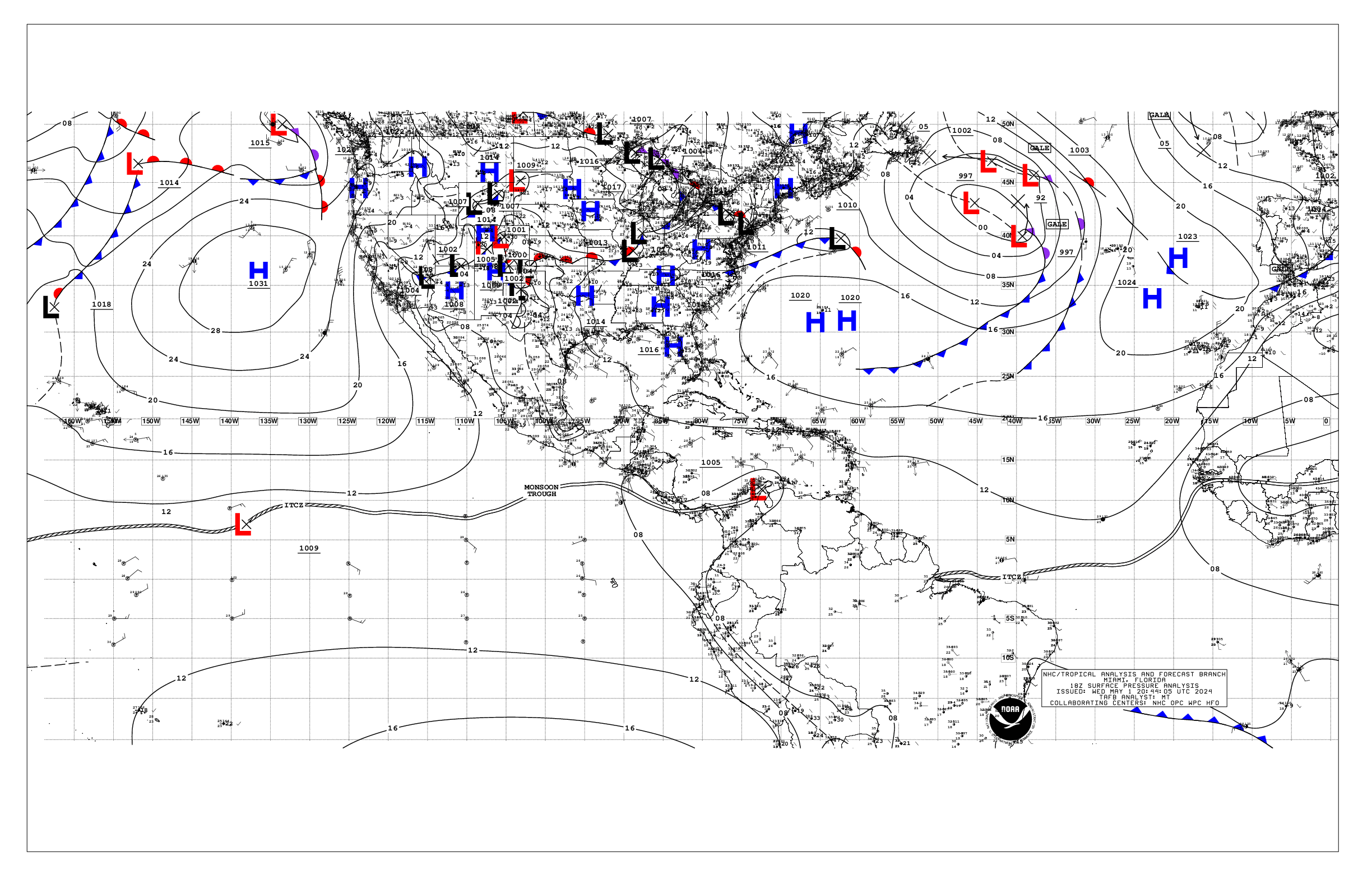
Based on 1800 UTC surface analysis and satellite imagery through
2120 UTC.

...TROPICAL WAVES...

A far eastern Atlantic tropical wave has its axis along 23W from
03N to 15N. It is moving westward at 10 kt. Scattered moderate
convection is depicted from 04N to 06N between 24W and 28W.

An eastern Atlantic tropical wave has its axis along 39W from
02N to 16N moving westward at 15 to 20 kt. Scattered moderate
convection is depicted from 02N to 07N between 35W and 40W.

An eastern Caribbean tropical wave has its axis along 62W south
of 18N. Scattered showers and thunderstorms are depicted from
11N to 15N between 60W and 62W. This is wave is supporting
moderate to locally fresh winds across the Leeward Islands.

A western Caribbean tropical wave is along 80W south of 18N. It
is moving westward at about 20 to 25 kt. This wave is
interacting with an upper- level low, which is generating
scattered moderate convection off eastern Panama and off eastern
Honduras.

...MONSOON TROUGH/ITCZ...

The monsoon trough axis enters the Atlantic ocean near 19N16W,
and continues southwestward to 10N25W to 08N40W, where it
transitions to the ITCZ to 10N56W. Scattered moderate convection
is described in the Tropical Wave section above.

...GULF OF AMERICA...

Relatively weak high pressure ridging stretches westward from the
western Atlantic to across Florida and to the central Gulf. The
pressure gradient between the ridge, and the relatively lower
pressures over Texas and northeastern Mexico has induced moderate
to fresh SE winds west of 90W, with 3-5 ft seas. Elsewhere,
light to gentle winds prevail along with seas 1 to 4 ft.
Scattered showers and thunderstorms are offshore the Texas coast.

For the forecast, high pressure will continue to prevail across
the NE Gulf. The pressure gradient between the area of high
pressure and relatively lower pressures over Texas and
northeastern Mexico will generally support mostly fresh southerly
winds over the western and central Gulf through the weekend.
These winds are expected to diminish to gentle to moderate speeds
early next week. Slight to moderate seas will accompany these
winds. The weak high pressure over the eastern Gulf will support
light winds and slight seas there through late Mon. A new high
center will become established over the central Gulf by midweek,
with similar conditions expected over much of the basin at that
time.

...CARIBBEAN SEA...

Please refer to the Tropical Waves section above for convection
across the basin.

The subtropical ridge extends north of the area over the western
Atlantic. The pattern between this ridge and tropical waves over
the eastern and western Caribbean is supporting fresh to strong
trade winds across the central Caribbean, where seas are 7-9 ft.
Moderate to fresh trade winds prevail elsewhere, with 5-7 ft
seas, except for gentle SE winds 3-5 ft over the far northwestern
Caribbean.

For the forecast, the subtropical ridge will prevail north of
the area into next week. The pressure gradient between the high
pressure and the Colombian low will support fresh to strong trade
winds and moderate to rough seas in the central Caribbean
through the forecast period, with highest winds and seas expected
off the coast of Colombia. Pulsing fresh to strong winds and
moderate to rough seas are expected in the Gulf of Honduras
nightly well into the upcoming week. Moderate to fresh winds are
expected over much of the remainder of the Caribbean through the
middle portion of next week. A tropical wave currently east of
the Lesser Antilles will move through the eastern Caribbean Sun
through late Mon, and across the rest of the basin through late
Wed. Scattered showers and thunderstorms are expected near the
wave.

...ATLANTIC OCEAN...

The subtropical ridge extends across the entire Atlantic north of
20N, anchored by 1022 mb near 26N52W. The pattern is supporting
moderate to fresh trade winds south of 20N, with 5-7 ft seas,
reaching 8 ft northeast of Barbados. Gentle breezes prevail north
of 20N, with 3-5 ft seas in a broad mix of swell. Upper jet
dynamics are supporting scattered showers and thunderstorms along
30N between 65W and 75W.

For the forecast west of 55W, surface troughing will linger near
and offshore Florida into early next week. Moderate to fresh
trade winds will pulse to strong south of 22N into early next
week, then be at mostly fresh speeds through the rest of the
forecast period.

$$
Christensen


 NHC on Facebook
 NHC on X
 NHC on YouTube
 NHC Blog: