000
AXNT20 KNHC 251555
TWDAT

Tropical Weather Discussion
NWS National Hurricane Center Miami FL
1815 UTC Fri Sep 25 2026

Tropical Weather Discussion for North America, Central America
Gulf of America, Caribbean Sea, northern sections of South
America, and Atlantic Ocean to the African coast from the
Equator to 31N. The following information is based on satellite
imagery, weather observations, radar and meteorological analysis.

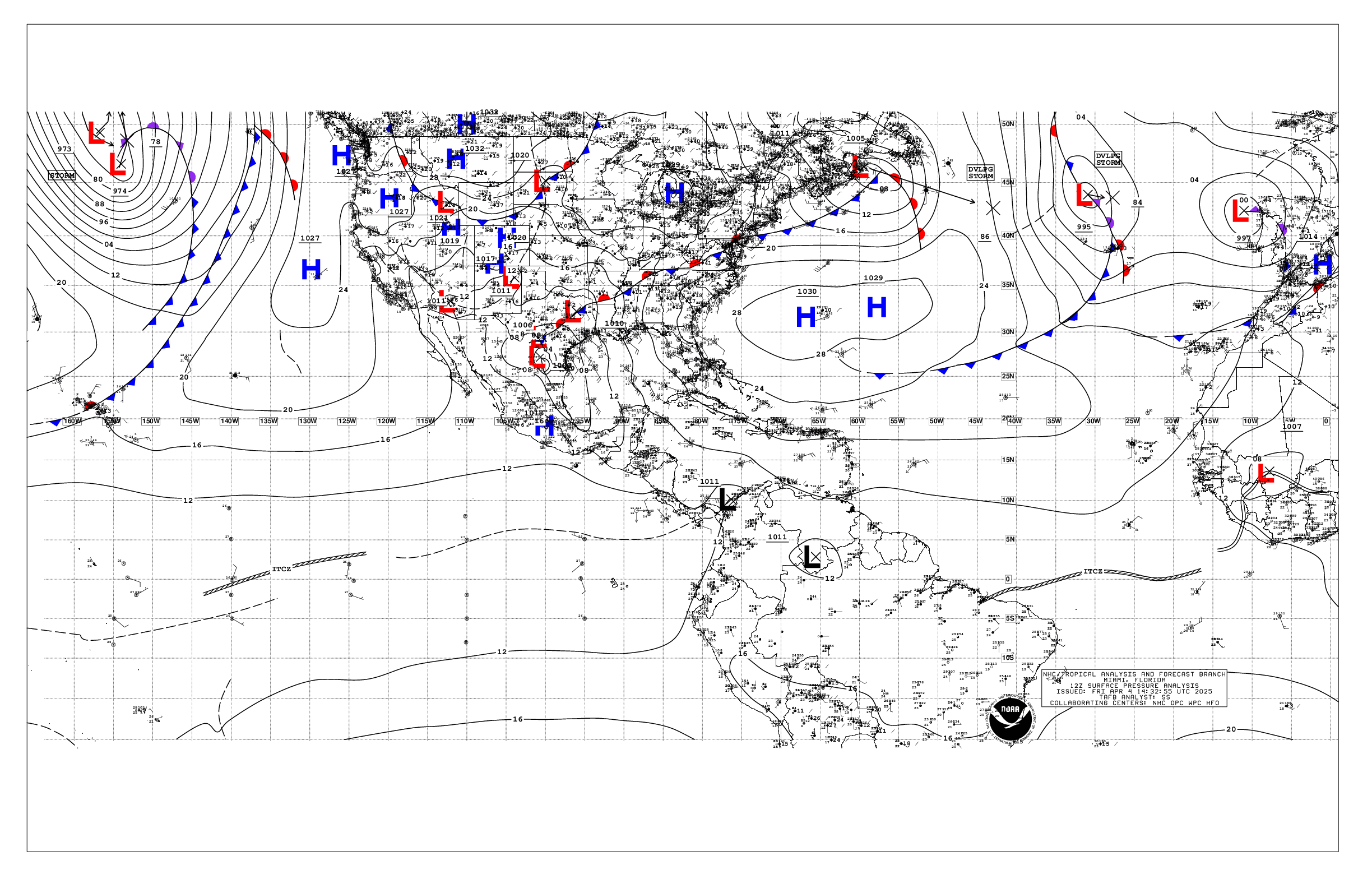
Based on 1200 UTC surface analysis and satellite imagery through
1430 UTC.

...SPECIAL FEATURES...

Tropical Storm Fay is centered near 30.1N 42.5W at 25/1500 UTC
or 900 nm WSW of the Azores, moving W at 3 kt. Estimated minimum
central pressure is 1002 mb. Maximum sustained wind speed is 50
kt with gusts to 60 kt. Peak seas to 18 ft are occurring within
60 NM nm across the N semicircle. Numerous moderate and scattered
strong convection is noted from 29N-31N between 40W-44W. A
gradual turn to the west-southwest then southwest at a slower
forward speed is expected over the next few of days. Some slight
strengthening is possible over the next few hours. Gradual
weakening, however, is still expected through the weekend.

Tropical Storm Gonzalo is centered near 14.7N 22.6W at 25/1200
UTC or 100 nm E of the Southernmost Cabo Verde Islands, moving
NNW at 9 kt. Estimated minimum central pressure is 1002 mb.
Maximum sustained wind speed is 45 kt with gusts to 55 kt.
Peak seas are near 20 ft and a 0900 UTC altimeter pass indicated
seas to 15 ft between and just to the north of the eastern Cabo
Verde Islands. Numerous moderate to strong convection extends
from 10N-21N between 17W-22W. The NNW motion is expected to
continue over the next few days, with a slower forward speed this
weekend. On the forecast track, the center will pass near or over
portions of the Cabo Verde Islands later today and tonight. A
gradual weakening trend is forecast to begin tonight and continue
through the weekend. Swells generated b y the storm are expected
to affect the Cabo Verde Islands through Saturday. These swells
are likely to cause life-threatening surf and rip current
conditions. Please consult products from your local weather
office.

Please read the latest HIGH SEAS FORECAST issued by the National
Hurricane Center at website -
https://www.nhc.noaa.gov/text/MIAHSFAT2.shtml and the latest Fay
and Gonzalo NHC Forecast/Advisories and Public Advisories at
www.hurricanes.gov for more details.

Very Large NE Swell: A cold front extends from 31N72W across the
N Bahamas and to the Florida Straits. Seas are 8 to 13 ft
northwest of a line from 31N70W to the N Bahamas and the Florida
peninsula north of 26N. The highest seas of 12-13 ft are occurring
north of 30N between 76W-80W as well as up to 12 ft are over the
Gulf Stream within 60 NM of the Florida peninsula north of 28N.
Buoy 41010 at 28.9N 78.5W 120 NM east of Cape Canaveral is
showing 11 ft seas as of 1520 UTC. Fresh to strong winds and
rough to very rough seas will follow the front through Sat
morning, before starting to decrease.

Heavy Rainfall in Central America and Southern Mexico: A mid to
upper-level trough is over the NW Caribbean while relatively warm
sea surface temperatures and abundant low level moisture are
present. This pattern will aid in funneling enhanced tropical
moisture across Central America and the western Caribbean,
supporting periods of heavy rainfall through Sat. There is still
some uncertainty regarding the exact location of heaviest
rainfall, but for now heavy rainfall looks likely across extreme
southeastern Mexico near Chiapas, southern and central Guatemala,
western Honduras, and El Salvador. Heavy rainfall across these
regions will create the possibility of life-threatening flash
flooding and landslides. Please refer to local weather services as
well as the International Desk at the Weather Prediction Center at
https://www.wpc.ncep.noaa.gov/international/intl2.sthml for more
information.

...TROPICAL WAVES...

A tropical wave is analyzed along 55W, from 07N to 16N, moving
west at 15 kt. There is no significant convection associated with
it at the time.

A tropical wave is in the W Caribbean along 77W, south of 13N
into central Colombia, moving westward at 15-20 kt. There is no
significant convection associated with it at the time.

...MONSOON TROUGH/ITCZ...

The monsoon trough extends from coastal Senegal near 16N17W
through Tropical Storm Gonzalo to 08N34W. The ITCZ begins at
08N134W to 09N56W. See T.S. Gonzalo in the Special Features
section for information on convection.

...GULF OF AMERICA...

A weak cold front extends from the Florida Straits to 27N89W,
where it becomes stationary to the E Texas coast. Winds across the
Gulf are gentle to moderate with seas 2-4 ft. No significant deep
convection is occurring this morning over the Gulf.

For the forecast, the cold front will move E of the Gulf tonight
into Sat. Moderate to locally fresh winds will follow the front
through tonight. Elsewhere, gentle to moderate winds will prevail
through Sat night. Winds will diminish slightly Sun into early
next week.

...CARIBBEAN SEA...

Please see Special Features section above for information on
upper-level low pressure across the far western Caribbean that is
expected to produce areas of heavy rainfall over portions of
Central America through tomorrow.

The cold front north of the Caribbean has reduced the pressure
gradient across the Caribbean with trades only gentle to moderate
locally fresh. Seas are 2-5 ft. Scattered moderate convection is
occurring over the SW Caribbean south of 11N due to the monsoon
trough from the northeast Pacific.

For the forecast, a weak pressure will support moderate to fresh
trades over the S central Caribbean, and gentle to moderate winds
elsewhere. Slight to moderate seas will be over the NW Caribbean
with moderate seas elsewhere.

...ATLANTIC OCEAN...

See Special Features section above for information on Tropical
Storm Fay and Tropical Storm Gonzalo.

A cold front extends from 31N72W across the N Bahamas and to the
Florida Straits. Winds ahead of the front north of 26N are SW
fresh to locally strong, while winds behind the front north of 27N
are N fresh to locally strong. Seas are 8 to 13 ft northwest of a
line from 31N70W to the N Bahamas and the Florida peninsula north
of 26N. Numerous moderate to scattered strong convection is
occurring within 300 NM east of the front north of 23N. There also
is a surface trough extending from 24N64W to 25N55W with scattered
moderate convection occurring from 22N-25N between 55W-60W. The
weak pressure gradient between ridging with the Bermuda-Azores
High well north of our waters to lower pressure along the ITCZ is
forcing only gentle to moderate trades over the tropical and
subtropical north Atlantic. Seas away from the two tropical storms
and cold front are 3-7 ft.

For the forecast west of 55W, the cold front will reach from near
Bermuda to near central Cuba Sat night before starting to weaken.
Scattered showers and isolated thunderstorms are expected along
the frontal boundary. Fresh to strong winds and rough to very
rough seas will follow the front through Sat morning, before
starting to decrease.

$$
Landsea/Levine


 NHC on Facebook
 NHC on X
 NHC on YouTube
 NHC Blog: