000
AXNT20 KNHC 062303
TWDAT

Tropical Weather Discussion
NWS National Hurricane Center Miami FL
0015 UTC Sun Jun 7 2026

Tropical Weather Discussion for North America, Central America
Gulf of America, Caribbean Sea, northern sections of South
America, and Atlantic Ocean to the African coast from the
Equator to 31N. The following information is based on satellite
imagery, weather observations, radar and meteorological analysis.

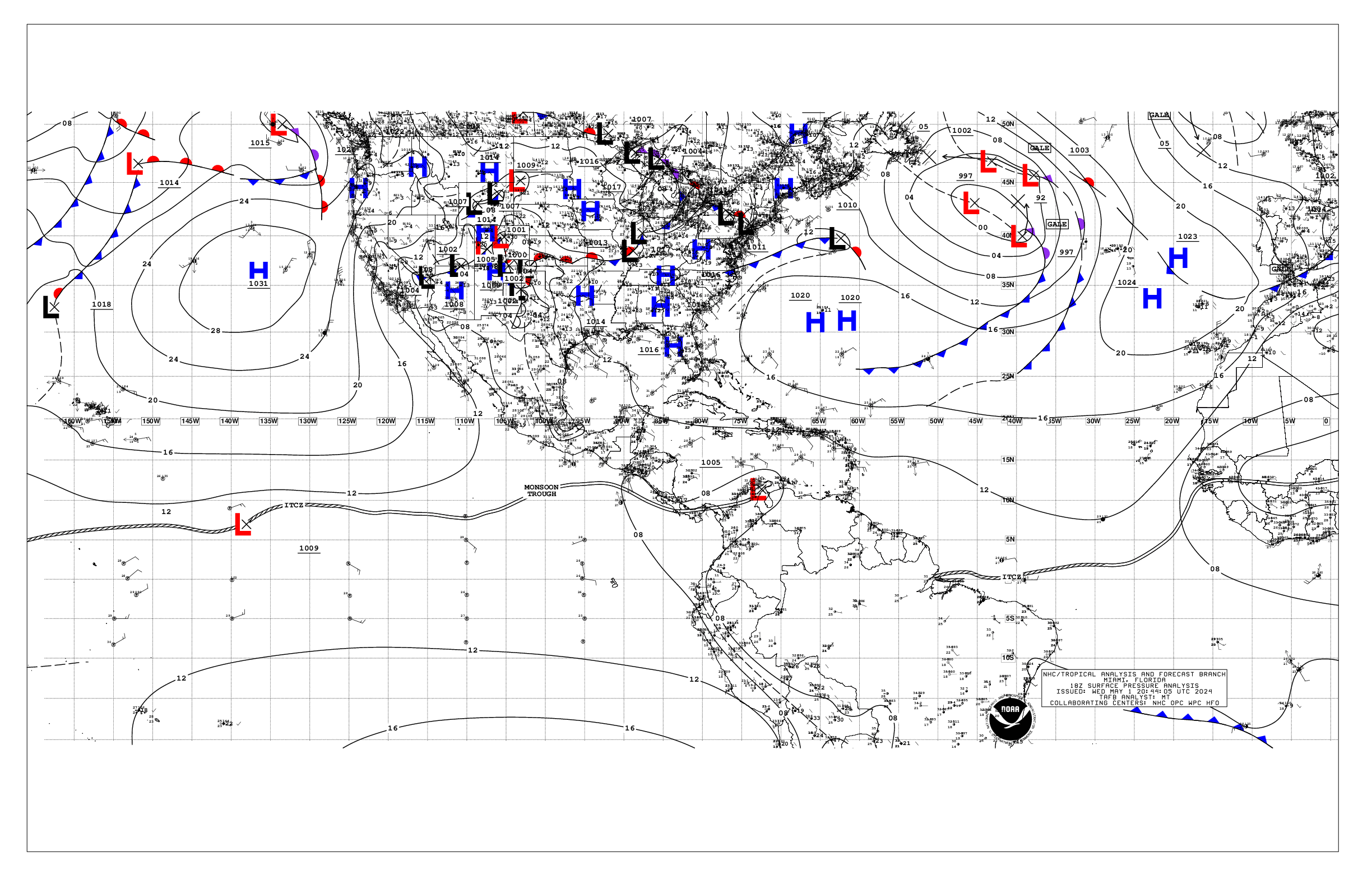
Based on 1800 UTC surface analysis and satellite imagery through
2230 UTC.

...TROPICAL WAVES...

The tropical wave that emerged off of Africa earlier this morning
has it axis along 20W, south of 15N, moving W at around 15 kt.
Widely scattered moderate convection is depicted from 03N to 08N
between 14W and 26W.

A tropical wave is near 32W, south of 13N, moving W at 15 kt.
Scattered moderate convection is noted where the wave meets the
monsoon trough from 02N to 06N between 27W and 34W.

Another tropical wave is along 57W-58W, south of 13.5N, moving
westward at 15 to 20 kt. Scattered moderate isolated strong
convection is evident from 02.5N to 12N between 51W and 59W.

A tropical wave is over the eastern Caribbean Sea along 66W,
south of 15N, moving westward at 15 to 20 kt. The wave appears to
enhance convection over portions of Venezuela, but no significant
convection is seen over the Caribbean.

Another tropical wave is moving across the western Caribbean Sea.
Its axis is along 82W-83W, south of 19N into the EPAC region,
moving W at 15 kt. Scattered moderate to strong convection is
observed behind the wave N of 15N and across the waters and
islands of Jamaica, and eastern Cuba, as it interacts with an
upper trough along 80W. Scattered moderate to strong convection
is also near the southern portion of the wave axis and along the
eastern end of the EPAC monsoon trough.

...MONSOON TROUGH/ITCZ...

The monsoon trough enters the Atlantic through the coast of
Senegal near 14N17W and continues southwestward to 03N35W. The
ITCZ extends from 03N35W to the coast of Brazil near 01.5N50W.
Widely scattered moderate convection is about the ITCZ from 02N
to 06N between 35W and 48W. Additional convection across the area
is related to the tropical waves mentioned above.

...GULF OF AMERICA...

High pressure over the western Atlantic W of Bemuda extends
west-southwestward into the SE United States and NE Gulf waters,
supporting gentle to moderate SE to S winds across most of the
basin, with the exception of moderate to fresh E-NE winds through
the Florida Straits. Seas are slight to moderate within these
wind speeds, with maximum seas to 6 ft occurring NW of the Yucatan
Peninsula. A surface trough over the western part of the basin is
supporting scattered moderate convection south of 26.5N and west
of 92W. Scattered moderate convection over coastal Mississippi and
Alabama is shifting into those area coastal waters.

For the forecast, the west Atlantic ridge will continue to
dominate the Gulf region, supporting gentle to moderate E to SE
winds over the eastern Gulf and moderate to fresh SE to S winds
over the western Gulf through Mon. Winds will be easterly at
mostly fresh speeds across most of the western and central Gulf S
of 26N through midweek. The exception will be off the Yucatan
Peninsula, where a diurnal trough will support moderate winds to
pulse to fresh, occasionally strong, during the evenings through
Wed. Slight to moderate seas will prevail with these winds.

...CARIBBEAN SEA...

Two tropical waves are moving westward across the Caribbean Sea.
Please, see the Tropical Waves section above for more details.

High pressure north of the area is centered just W of Bermuda, and
is combining with lower pressures across South America to support
moderate to locally fresh E-SE trade winds and moderate seas
across the majority of the basin, with the exception of the SW
Caribbean where light to gentle winds are noted. An upper level
trough along 80W is supporting scattered moderate to strong
convection N of 15N between 70W and 80W, including diurnal
convection over Hispaniola, Jamaica, and Cuba, as will as along
the monsoon trough in the SW Caribbean. Elsewhere, patches of low
level clouds, embedded in the trade wind flow, are noted
producing isolated to scattered passing showers.

For the forecast, moderate to fresh E to SE trade winds and
moderate seas will persist across the Caribbean through Sun as the
Atlantic ridge north of the area weakens and shifts eastward.
Winds will begin to increase again over the central Caribbean late
tonight into Sun, and over the NW part of the basin Sun night
into Mon as the pressure gradient tightens between the Atlantic
ridge and a broad area of low pressure located over the eastern
Pacific offshore waters of Central America.

...ATLANTIC OCEAN...

Three tropical waves are moving westward between the W coast of
Africa and the Lesser Antilles. Please refer to the Tropical
Waves section for more details.

A stalled frontal boundary extends through 31N58W to near 25N76W.
SE of the front, a surface trough extends from 27N64W to eastern
Cuba. Scattered showers and thunderstorms are along and S of these
two features. 1022 mb high pressure over the southeastern United
States and the western Atlantic follows this frontal boundary. The
remainder of the Atlantic forecast area is dominated by a broad
subtropical ridge, anchored by a 1028 mb high pressure situated
SW of the Azores near 33N33W. Under the influence of this
feature, a gentle to moderate E to SE flow is seen N of 22N E of
front to about 45W. Fresh to strong  NE winds and rough seas are
found north of 17N and east of 40W, including the Canary Islands.
The strongest winds are between the islands. Moderate to fresh
trades and moderate seas are elsewhere S of 20N between the coast
of Africa and the Lesser Antilles, except between Barbados and 50W
where recent satellite altimeter data showed a broad zone of 7-8
ft seas.

For the forecast west of 55W, the aforementioned frontal boundary will
will dissipate tonight. A surface trough extending to its
southeast and into the southeastern Bahamas will drift westward
through Mon night. A new cold front will reach from near 31N59W
by late Tue, from near 30N55W to 26N63W and stationary to 27N69W,
then shift E of the area Thu as a high center N of the area slides
eastward along 33N. This weather pattern will generally support
gentle to moderate winds and moderate seas into next week, except
for moderate to fresh trades S of 22N between Hispaniola and Cuba
starting late Wed.

$$

Stripling


 NHC on Facebook
 NHC on X
 NHC on YouTube
 NHC Blog: