000
AXNT20 KNHC 110417
TWDAT

Tropical Weather Discussion
NWS National Hurricane Center Miami FL
0615 UTC Tue Aug 11 2026

Tropical Weather Discussion for North America, Central America
Gulf of America, Caribbean Sea, northern sections of South
America, and Atlantic Ocean to the African coast from the
Equator to 31N. The following information is based on satellite
imagery, weather observations, radar and meteorological analysis.

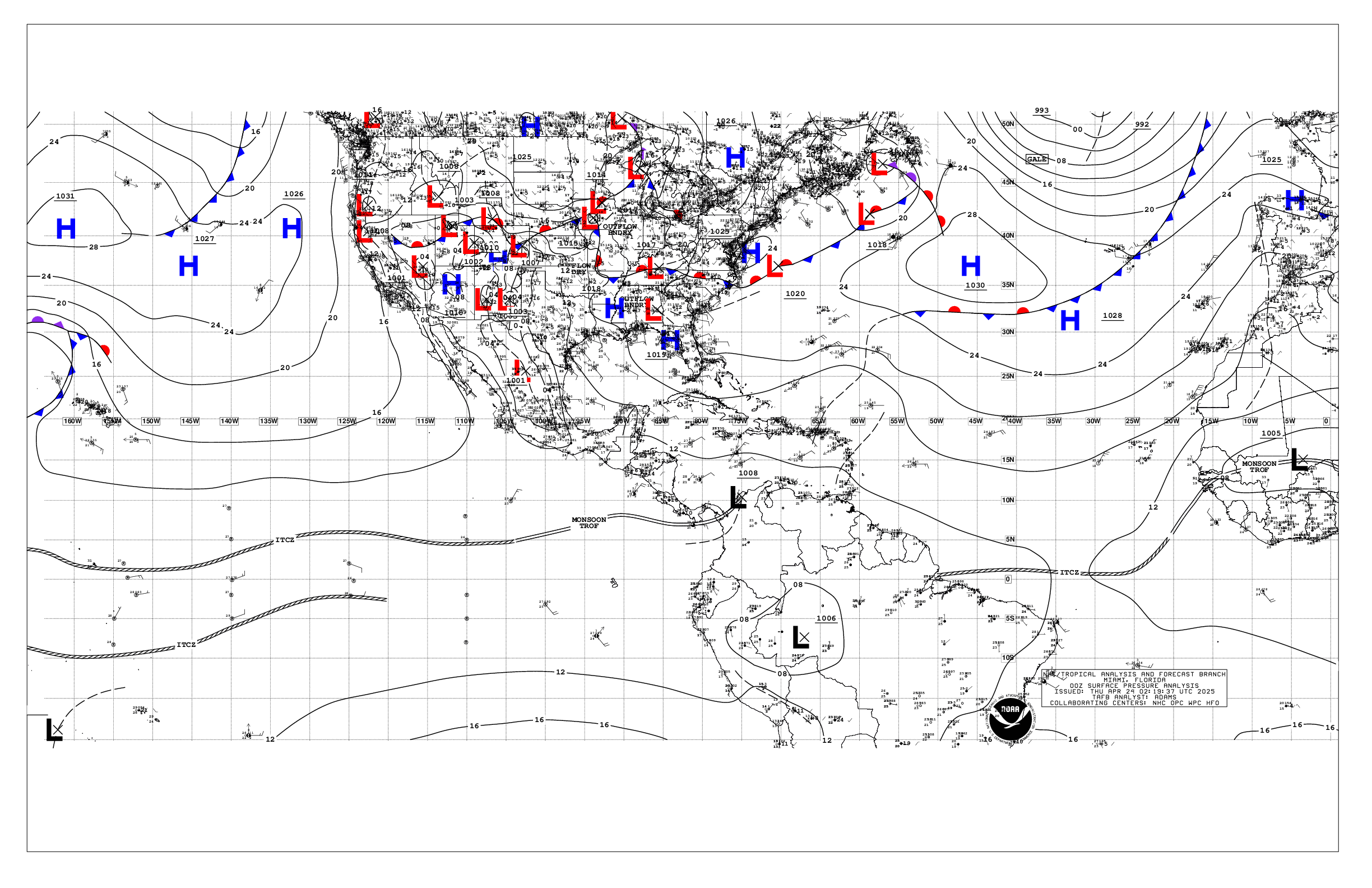
Based on 0000 UTC surface analysis and satellite imagery through
0330 UTC.

...TROPICAL WAVES...

The axis of a tropical wave is near 29W from 05N to 17N, moving
westward at 10 to 15 kt. Scattered moderate convection is from 06N
to 13N between 23W and 31W.

The axis of a tropical wave is along 47W-48W from 06N to 18N,
moving west at around 15 kt. Scattered moderate convection is from
08N to 14N between 46W and 53W.

The axis of a tropical wave is near 60W from 13N to 23N, moving
west at 15 kt. Isolated moderate convection is about the wave axis
from 16.5N to 18N between 59W and 61W.

The axis of a tropical wave is near 80W S of 20N, moving west at
15 to 20 kt. Widely scattered showers are in the vicinity of the
wave N of 18N.

...MONSOON TROUGH/ITCZ...

The monsoon trough enters the Atlantic through the coast of
Mauritania near 19.5N16.5W and continues southwestward to 10N31W
to 12.5N41W to 10.5N49W. The ITCZ extends from 11N51W to 10.5N58W
to 11.5N61W. Aside from the convection mentioned in the tropical
waves section, scattered moderate isolated strong convection is
noted from 08N to 11.5N E of 23W to the coast of Africa, while
scattered moderate to strong convection is noted from 07.5N to
12.5N between 33W and 40W.

...GULF OF AMERICA...

A surface ridge extends from the Bermuda High near 29N71W westward
across the northeastern Gulf. Gentle to locally moderate E to SE winds,
and slight seas generally prevail across the Gulf waters. Typical
moderate to locally fresh NE winds are occurring along the N and W
coastal waters of the Yucatan Peninsula, where seas are 2 to 4 ft.
Moderate to fresh easterly winds are blowing through the Straits
of Florida, producing seas to 4 ft. A low level trough continues
to drift westward across the east central Gulf and is yielding a
small cluster of moderate convection well offshore of the mouth of
the Mississippi River. Afternoon convection across central
Florida has shifted westward over the waters SW of the entrance to
Tampa Bay, and is quickly weakening.

For the forecast, the current ridge across the northern Gulf will
dominate the general wind flow pattern across basin through Sat
night. Gentle to moderate E to SE winds will generally prevail
across the basin, with the exception of pulses of fresh winds
occurring north and west of the Yucatan Peninsula and into the Bay
of Campeche each evening and night as a diurnal surface trough
migrates from the Yucatan Peninsula westward across the SW Gulf.
Slight to moderate seas are expected through the forecast period.

...CARIBBEAN SEA...

The pressure gradient between a 1023 mb Bermuda High near 29N71W and
a 1007 mb Colombian Low is supporting fresh to strong winds, and
moderate to rough seas, over the central Caribbean S of 17.5N
between 67W and 79W. Recent satellite scatterometer winds showed
winds near gale-force off the northern coast of Colombia, where
seas are estimated at around 10 ft. Fresh NE winds prevail through
the Windward Passage and across the Gulf of Honduras, while
moderate to fresh trade winds prevail across the NE Caribbean to
the Mona Passage in advance of an approaching tropical wave.
Gentle to moderate winds, and slight to moderate seas prevail
elsewhere across SE and NW portions. Ahead of the tropical wave
along 80W scattered moderate convection is noted between the
Cayman Islands and the east coast of the Yucatan, across the Gulf
of Honduras, and along most of the coast of Nicaragua.

For the forecast, the pressure gradient between ridging over the
western Atlantic and lower pressure in northern South America will
continue to support fresh to strong trades over the central
portion of the Caribbean basin through Wed night. The ridge will
gradually shift southward to near 26N by Thu, and coincide with
the arrival of a tropical wave, allowing for the fresh to strong
trades to significantly expand in coverage to cover the eastern
basin into early Sat. Winds are expected to reach near-gale force
offshore Colombia and in the Gulf of Venezuela each night, except
Wed night. Winds will pulse up to fresh to strong speeds during
the evenings and at night in the the Windward Passage through the
forecast period. Otherwise, moderate to fresh trades will prevail
elsewhere.

...ATLANTIC OCEAN...

High pressure prevails over the waters N of 20N, anchored by a
1023 mb Bermuda High centered near 29N71W, and a 1023 mb high
centered near 27.5N45.5W. Light to gentle winds generally prevail
over the waters N of 24N and west of 30W, with slight to moderate
seas. Moderate to locally fresh trade winds are noted S of 24N and
west of 30W, and moderate seas to 6 ft. Fresh to locally strong N
to NE winds continues from the Canary Islands to 19N to the east
of 25W, where seas are 5 to 8 ft. Saharan Air dominates most of
the basin N of 15N from Africa through the southern Bahamas.

For the forecast west of 55W, the current Atlantic ridge will
shift slowly southward to along 28N Tue and to near 26N by Thu
then change little into Sat. The pressure gradient will tighten
over the southern portion leading to an increase of the trades
from the Bahamas eastward. Fresh trades will prevail N of
Hispaniola and in the approach to the Windward Passage through the
period, pulsing to strong speeds each night. Of note, an area of
low pressure located about 500 miles southwest of the Cabo Verde
Islands is producing active showers and thunderstorms.
Environmental conditions are forecast to gradually become more
conducive for development during the next day or two, and a
tropical depression will likely form during the latter half of
this week while this system moves westward to west- northwestward
across the central tropical Atlantic. There is a high chance for
tropical formation of this system within the next 7 days.

$$
Stripling


 NHC on Facebook
 NHC on X
 NHC on YouTube
 NHC Blog: