000
AXPZ20 KNHC 100335
TWDEP

Tropical Weather Discussion
NWS National Hurricane Center Miami FL
0405 UTC Fri Apr 10 2026

Tropical Weather Discussion for the eastern Pacific Ocean from
03.4S to 30N, east of 120W including the Gulf of California, and
from the Equator to 30N, between 120W and 140W. The following
information is based on satellite imagery, weather observations,
radar, and meteorological analysis.

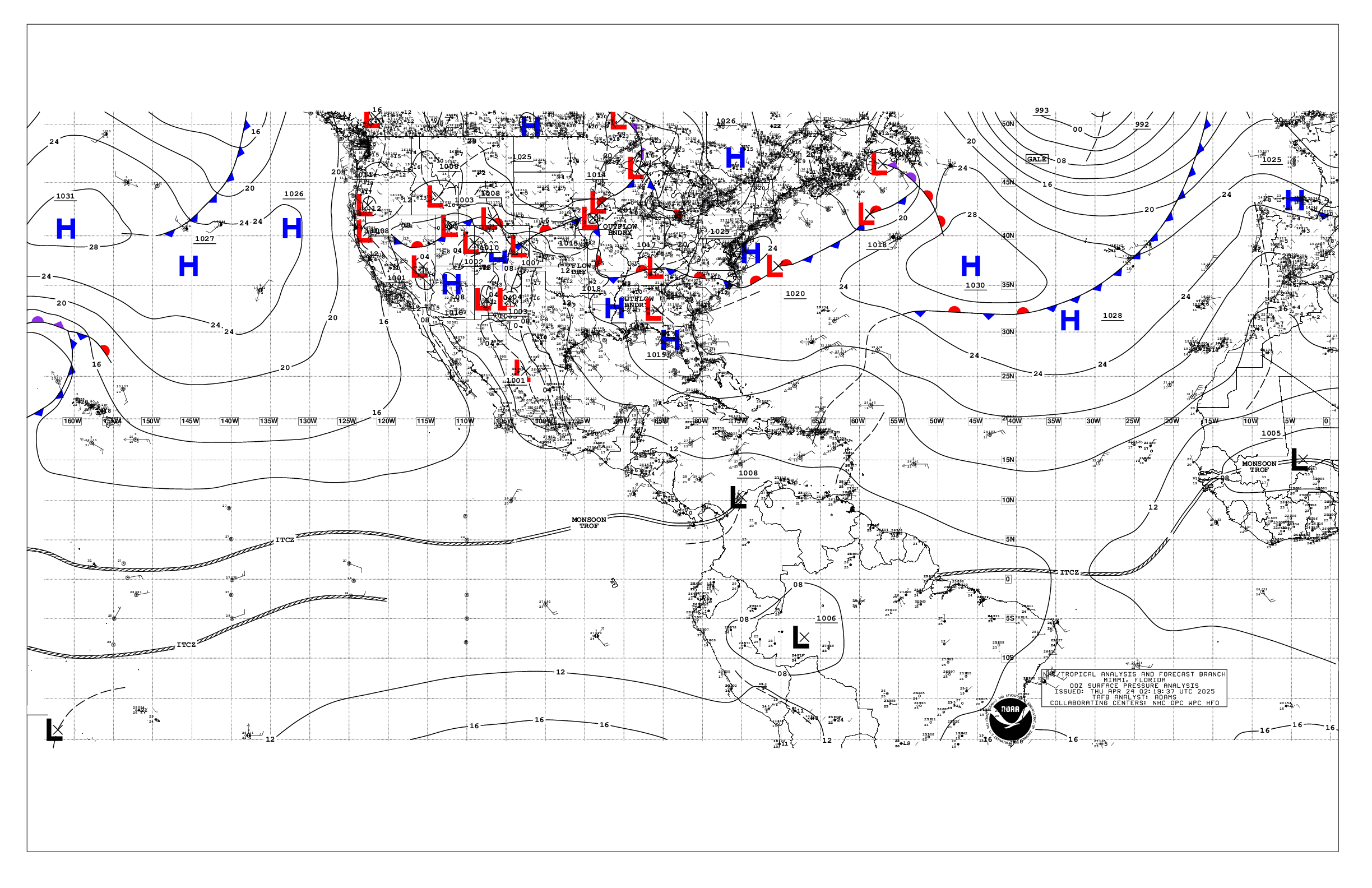
Based on 0000 UTC surface analysis and satellite imagery through
0300 UTC.

...INTERTROPICAL CONVERGENCE ZONE/MONSOON TROUGH...

A surface trough extends from 05N78W to a 1007 mb low near
03.5N86W to 05N96W. The ITCZ continues from 05N100W to 06N120W
to 04N140W. A second ITCZ is south of the Equator and runs from
05.5S88W to 02S110W to 01S123.5W. Scattered moderate to isolated
strong convection can be found from 00N to 06N between 83W and
91.5W. Scattered moderate convection is noted from 00.5N to
09.5N between 116W and 140W.

...OFFSHORE WATERS WITHIN 250 NM OF MEXICO...

Strong to near-gale N winds are noted across the Gulf of
Tehuantepec and downwind to 15.5N. Seas are 5 to 6 ft with these
winds. A weak ridge continues to dominate the offshore waters of
Baja California supporting gentle to moderate NW to N winds with
moderate seas, except for locally fresh winds north of Punta
Eugenia. Light to gentle winds prevail across most of the Gulf
of California. Elsewhere across the Mexican offshore waters,
light to gentle winds and moderate seas, primarily in southerly
swell, prevail.

For the forecast, pulsing fresh to strong northerly winds are forecast
in the Tehuantepec region through Sun morning, with seas building
up to 7 or 8 ft. Afterwards, mainly moderate to fresh N winds are
expected. Moderate to locally fresh NW winds and moderate seas
are forecast off Baja California through Mon under the influence
of a ridge. By Mon night into Tue, the pressure gradient may tighten
enough between the ridge to the W and lower pressures inland Mexico
to support moderate to fresh NW winds off the Baja California
Peninsula. Fresh to locally strong SW to W winds are forecast in
the northern Gulf of California Fri night through Sun night ahead
of a couple of frontal boundaries approaching Baja California
Norte. Elsewhere, winds will be moderate or weaker with moderate
seas through the middle of next week.

....OFFSHORE WATERS WITHIN 250 NM OF CENTRAL AMERICA, COLOMBIA,
AND WITHIN 750 NM OF ECUADOR...

Fresh to strong gap winds prevail across the Gulf of Papagayo
and downwind to near 87W. Seas are 4 to 6 ft with these winds.
Farther east, moderate to fresh N winds and seas of 3 to 4 ft
are present in the Gulf of Panama, and downstream of the Azuero
Peninsula. Light to gentle winds and moderate seas dominate the
remainder of the offshore forecast waters.

For the forecast, fresh to strong gap winds are expected mainly
during the nighttime and early morning hours in the Papagayo area
and downwind to near 90W through at least Sun night. Winds up to
30 kt, and seas up to 9 ft are forecast during the upcoming weekend.
In the Gulf of Panama, moderate northerly winds, occasionally
fresh, are forecast throughout the forecast period, with stronger
conditions most likely during the upcoming weekend. Light to gentle
winds and moderate seas will prevail elsewhere.

...REMAINDER OF THE AREA...

A ridge dominates the northern forecast waters N of 17N and W of
112W, including the Revillagigedo Islands, with a 1016 mb high
pressure center located near 27N123W. Multilayer clouds, with
possible showers, associated with strong upper level winds, are
noted from 15N to 23N W of 117W. A surface trough is analyzed is
this area and extends from 22N125W to 18N130W. The pressure
gradient between the ridge and lower pressures in the vicinity of
the ITCZ supports moderate to locally fresh winds from 04N to 22N
and west of 120W. Elsewhere, moderate or weaker winds and
moderate seas are occurring.

For the forecast, high pressure will remain in control of the
weather pattern across the forecast waters over the next several
days with little change in winds and seas. Mainly moderate winds
are expected in the trade wind zone. On Sun, another cold front
will reach the N waters extending from 31N120W to 27N140W.
Gentle to moderate N winds and moderate seas are expected in the
wake of the front.

$$
KRV


 NHC on Facebook
 NHC on X
 NHC on YouTube
 NHC Blog: