333
AXNT20 KNHC 041747
TWDAT

Tropical Weather Discussion
NWS National Hurricane Center Miami FL
1815 UTC Mon May 4 2026

Tropical Weather Discussion for North America, Central America
Gulf of America, Caribbean Sea, northern sections of South
America, and Atlantic Ocean to the African coast from the
Equator to 31N. The following information is based on satellite
imagery, weather observations, radar and meteorological analysis.

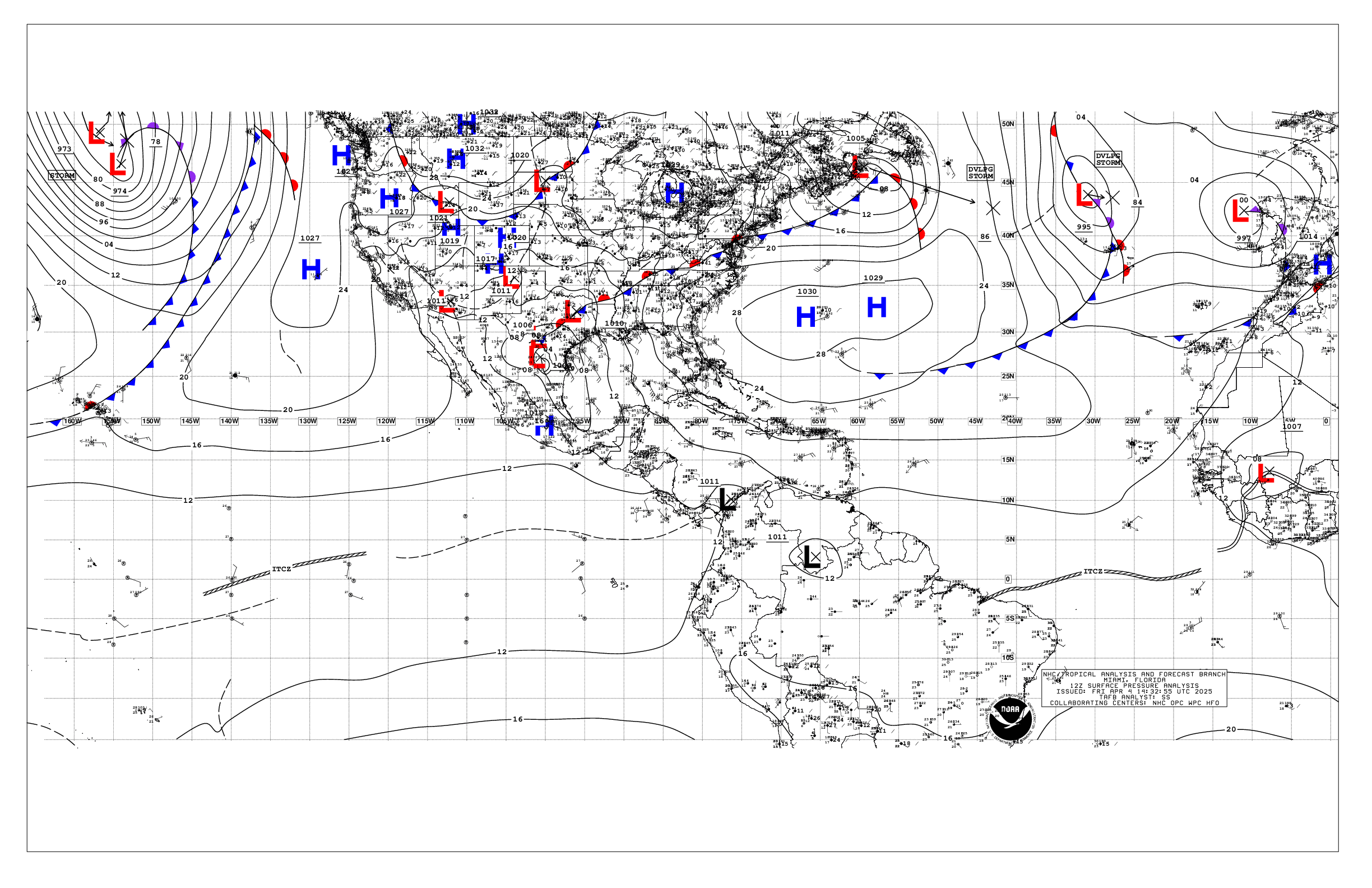
Based on 1200 UTC surface analysis and satellite imagery through
1730 UTC.

...TROPICAL WAVES...

A far eastern Atlantic tropical wave was introduced near 20W
based on an observed maximum in deep layer moisture as noted on
the Total Precipitable Water (TPW) imagery from CIMSS and on
computer vorticity model guidance. It is moving westward around
15 kt. Scattered moderate convection is within 120 nm west of the
wave from the Equator to 02N.

A central Atlantic tropical wave is analyzed from near 12N49W to
just inland Brazil near 01S47W. This wave was also inferred from
computer vorticity model guidance, and further supported by a
maximum in deep layer moisture that trails the wave axis as
depicted on the Total Precipitable Water (TPW) imagery from CIMSS.
It is moving westward at 15 to 20 kt. This wave is moving through
a very stable atmospheric environment. Scattered showers and
thunderstorms are within 60 nm east of the wave from the Equator
to 02N.

...MONSOON TROUGH/ITCZ...

The monsoon trough axis enters the Atlantic near 14N17W, and
continues southwestward to 07N23N and to the Equator at 27W,
where it transitions to the ITCZ to 02S32W to 01S38W and to
near 02S45W. Numerous moderate to isolated strong convection
is seen south of the ITCZ between 27W-32W. Scattered moderate
convection is within 240 nm south of the trough to near 01N between
21W-24W, and within 60 nm north of the ITCZ between 39W-44W.

...GULF OF AMERICA...

A stationary front extends across the Straits of Florida to just
east of the northeast tip of the Yucatan Peninsula while a weak 1018
mb high is centered over the far north-central Gulf just east of
southeastern Louisiana. Isolated showers are near some sections of
the front. Latest scatterometer and buoy data indicate mostly
moderate northeast winds south of 28N east of 87W and south of 25N
between 87W and 93W. Light to gentle anticyclonic winds are
elsewhere. Seas are 3 to 5 ft across the basin, except for lower
seas of 2 to 4 ft over the northern Gulf.

For the forecast, the aforementioned stationary front will weaken
into tonight then dissipate by Tue. Moderate to fresh southeast to
south return flow will set up in the W Gulf Tue night into Thu as
high pressure builds into the eastern Gulf. By the end of the week,
this high will settle over the entire basin, leading to tranquil
conditions for regional waters.

...CARIBBEAN SEA...

Moderate to fresh trades prevail across the eastern and central
Caribbean per latest scatterometer satellite data, except for strong
trades in the Gulf of Venezuela as well as offshore Colombia. Seas
with these winds are 5 to 7 ft. Light and variable winds are over
the northwestern part of the sea along with seas of 2 to 4 ft.

For the forecast, the pressure gradient between the Bermuda High
and the Colombian Low will support fresh to strong trades over the
south-central Caribbean, and moderate to fresh trades across the
remainder of the eastern and central Caribbean for the rest of
this week. The remnants of a frontal boundary will drift across
the northwestern Caribbean on Tue. Light and variable winds are
over the northwestern part of the sea along with seas of 2 to 4
ft.

...ATLANTIC OCEAN...

A stationary front extends from 31N62W southwestward to 28N70W to
weak low pressure of 1014 mb near the northern Bahamas, and
southwestward to the Straits of Florida. A recent scatterometer
satellite data pass indicates fresh to strong northeast winds north
of the frontal boundary to near 30N and between 72W and 80W.
Seas are 6 to 9 ft with these winds as seen in a recent altimeter
satellite data pass. A large area of moderate to heavy rain, with
embedded moderate convection is north of 27N between 70W and 74W and
northwest of the frontal boundary to 70W. Mostly fresh northeast
winds are elsewhere north of the frontal boundary along with seas of
5 to 7 ft. High pressure is over the central Atlantic while a couple
of weak troughs are over the eastern Atlantic: One extends from near
30N27W to 21N35W and the other one from 31N35W to a weak 1014 mb low
at 28N33W and to near 25N34W. No significant convection is occurring
with these features. However, the pressure gradient between these
features combined with lower pressures in western Africa is
sustaining moderate to fresh northeast winds from 19N to 28N between
the west African coast and 22W. Seas are 5 to 6 ft with these winds.
Elsewhere, moderate or weaker winds and 4 to 6 ft seas prevail.

For the forecast west of 55W, the aforementioned stationary front
and 1014 mb low pressure will remain nearly stationary into Tue
before the low moves eastward and the front transitions into a
cold front Tue night and Wed. Fresh to locally strong northeast
winds north of the front will slowly diminish through mid-week as
the boundary weakens, with quiescent conditions expected Wed and
Thu for area waters. A weak cold front may reach our NW waters Thu
night and steadily move eastward through the end of the week.

$$
Aguirre


 NHC on Facebook
 NHC on X
 NHC on YouTube
 NHC Blog: