000
AXNT20 KNHC 141456
TWDAT
Tropical Weather Discussion
NWS National Hurricane Center Miami FL
1815 UTC Thu May 14 2026
Tropical Weather Discussion for North America, Central America
Gulf of America, Caribbean Sea, northern sections of South
America, and Atlantic Ocean to the African coast from the
Equator to 31N. The following information is based on satellite
imagery, weather observations, radar and meteorological analysis.
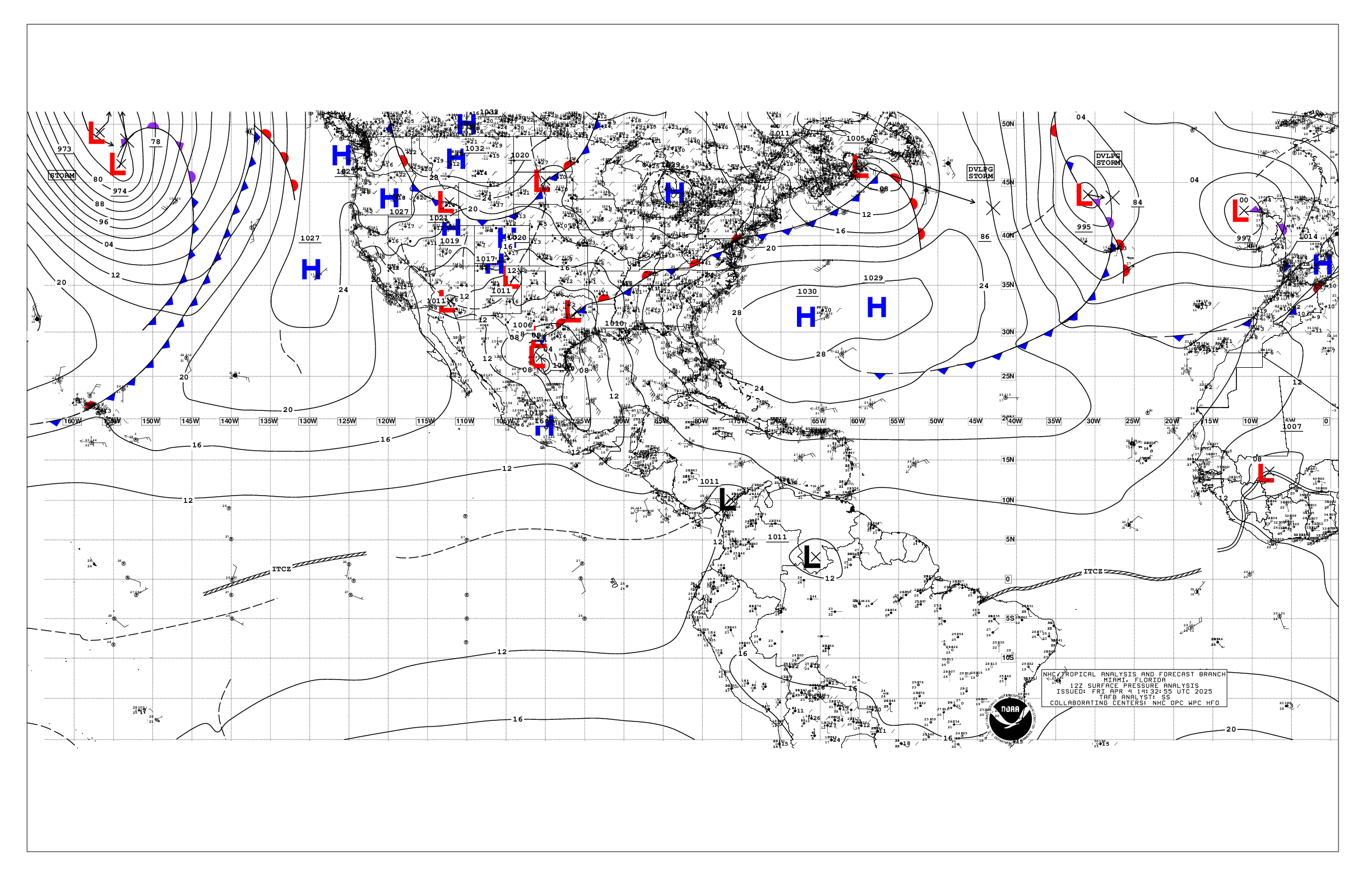
Based on 1200 UTC surface analysis and satellite imagery through
1445 UTC.
...TROPICAL WAVES...
A far eastern Atlantic tropical wave has its axis near 25W from
01N to 13N, moving westward at about 10 kt. The wave is in a very
dry surrounding environment marked by a dense area of Saharan Air
Layer (SAL) as seen in the GOES-E dust and GEO color imagery.
Scattered showers are along the wave axis from 03N to 05N.
A central Atlantic tropical wave has its axis near 46.5W from 01N
to 13N, moving westward at 10-15 kt. Scattered moderate convection
is S of 05N and W of 44W.
...MONSOON TROUGH/ITCZ...
The monsoon trough enters the Atlantic Ocean near 15N17W and
continues southwestward to 05N23W. The ITCZ continues from 03N27W
to 02N43W. Scattered to numerous moderate to isolated strong
convection within 240 nm on either side of the boundaries and W of
19W.
...GULF OF AMERICA...
A weak stationary front extends southwestward from low pressure
of 1010 mb that is located over northern Bahamas near 28N78W and
continues to northeast of the Yucatan Peninsula. The remainder of
the basin is under a weak high pressure system centered near
28N93W. The related weak pressure gradient supports moderate or
weaker winds and slight to moderate seas.
For the forecast, the frontal boundary over the SE Gulf will slowly
move southeastward and stall over the Straits of Florida today
and lose definition through Fri. Otherwise, weak high pressure
over the basin will maintain rather quiet conditions today.
Another weak cold front is forecast to enter the NE Gulf tonight
and dissipate over the eastern Gulf on Fri. Southeast winds are
forecast to reach moderate to fresh speeds over the western half
of the basin this weekend and into early next week as the pressure
gradient tightens between the western extension of Atlantic high
pressure and relatively lower pressures in west Texas.
...CARIBBEAN SEA...
The interaction between strong high pressure centered well north
of the basin over the central Atlantic, with relatively lower
pressures in northern South America is supporting a pressure
gradient that is sustaining fresh to strong trades in the south-
central Caribbean, including the Gulf of Venezuela. Seas of 6 to 8
ft are outside the Gulf of Venezuela per recent altimeter
satellite data pass. Latest scatterometer satellite data
indicates moderate to fresh trades across north-central, eastern
and southwestern portions of the sea while light to gentle winds
and slight seas are elsewhere in the basin.
For the forecast, the pressure gradient will continue to support
fresh to strong trades across the central Caribbean, with the
strongest winds offshore Colombia and in the Gulf of Venezuela.
Moderate to fresh trades are expected across the remainder of the
forecast waters, pulsing to strong in the Gulf of Honduras at
night Sat through Tue. Large E swell resulting in rough seas will
impact the tropical N Atlantic waters through late Sun, then begin
to subside on Mon.
...ATLANTIC OCEAN...
A frontal system extends across the western Atlantic, with 1010 mb
low pres centered near 28N78W. A cold front is analyzed from
31N72W to the low to 27N80W. Water vapor imagery shows a broad
mid to upper-level trough across the same area as the front. Very
dry sinking air with northwest flow aloft is moving across most of
the western half of the basin as the trough advances eastward. To
the east of trough, scattered to numerous moderate to strong
convection is evident north of 24N between 62W and 78W. Fresh to
strong southerly winds are north of about 27N between 63W and 73W.
Seas with these winds are 5 to 7 ft as noted by Sofar Ocean
Spotter buoys in the described area, and by an altimeter
satellite pass. A portion of a stationary front is along 31N
between 48W and 56W.
The remainder of the SW North Atlantic west of 55W is dominated by a
rather broad high pressure ridge axis. Moderate to fresh southeast
to south winds and seas of 4 to 7 ft are south of 28N and between
55W and 75W, with the exception of higher seas of 6 to 8 ft in long-
period east swell south of 16N between 55W and 60W.
For the forecast west of 55W, the pressure gradient between a
strong 1034 mb high pressure center centered well north of the
Azores and lower pressures in western Africa support fresh to
strong northerly winds and rough seas roughly from 13N to 26N and
east of 30W. Over the rest of the central and eastern tropical
Atlantic, mainly south of 28N and between 30W and 55W, moderate to
fresh easterly winds and rough seas prevail. Elsewhere, moderate
or lighter winds and moderate seas are noted.
$$
ERA