Home

287
AXNT20 KNHC 161703
TWDAT

Tropical Weather Discussion
NWS National Hurricane Center Miami FL
1815 UTC Mon Mar 16 2026

Tropical Weather Discussion for North America, Central America
Gulf of America, Caribbean Sea, northern sections of South
America, and Atlantic Ocean to the African coast from the
Equator to 31N. The following information is based on satellite
imagery, weather observations, radar and meteorological analysis.

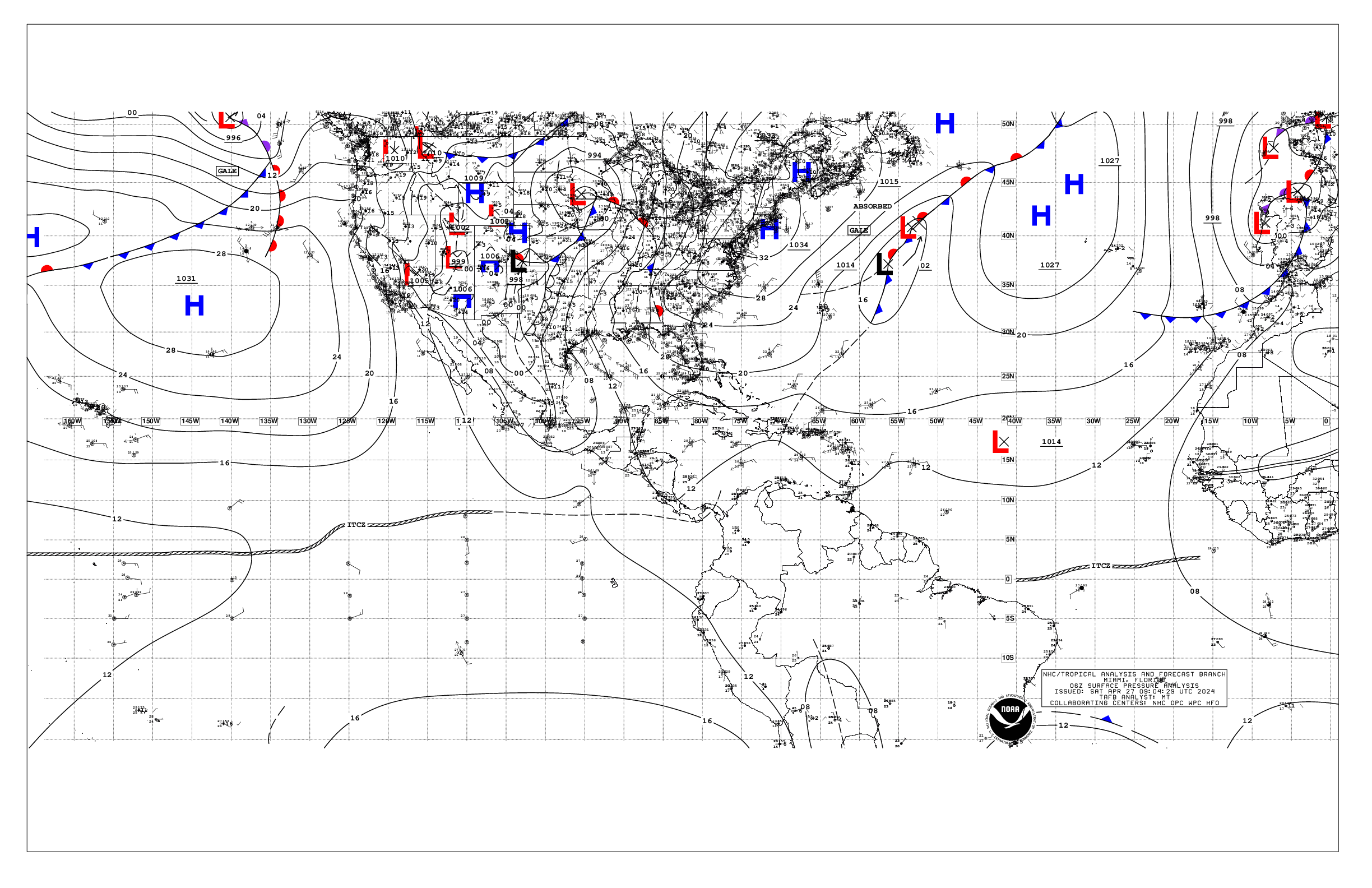
Based on 1200 UTC surface analysis and satellite imagery through
1520 UTC.

...SPECIAL FEATURES...

Gulf of America Storm Warning: A strong cold front currently
across the northwestern half of the Gulf will continue to move
southeastward across the rest of the Gulf through late tonight.
Widespread strong to near-gale northerly winds and very rough
seas will follow the front. These winds have increased to gale-
force off the coast of western Louisiana, Texas and NE Mexico
this morning. Expect strong gales to increase to storm-force off
the Mexican coast between Tampico and Veracruz today trough early
this evening. Seas will peak between 15 and 18 ft under the
strongest winds. Both winds and seas should gradually subside from
north to south starting this evening.

Please refer to the latest High Seas and Offshore Waters Forecasts
issued by the National Hurricane Center at websites
https://www.nhc.noaa.gov/text/MIAHSFAT2.shtml and
https://www.nhc.noaa.gov/marine/offshores.php for more details.

...MONSOON TROUGH/ITCZ...

The monsoon trough enters the Atlantic along the Guinea-Bissau
coast near 11.5N15.5W, then curves south-southwestward to 05N18W.
An ITCZ continues from 03N20W across 02N33W to the coast of
Brazil near 02.5S42W. Scattered moderate convection is noted
about the ITCZ south of 03.5N between 22W ad 47W.

...GULF OF AMERICA...

Please read the Special Features section above for information on
a Storm Warning.

A strong cold front stretches from the western Florida Panhandle
just east of Pensacola Bay, southwestward to near Tampico, Mexico.
Convergent southerly winds ahead of this front have produced a
line of scattered moderate to strong thunderstorms within 90 nm
ahead of the front and east of 90W, that extends inland from the
Florida Big Bend into southern Georgia. Strong to gale-force
northerly winds are occurring behind the front, with recent NW
Gulf buoy data indicating seas have already build to 13 ft.
Moderate to fresh S to SW winds and seas of 3 to 6 ft prevail
across the north-central and northeastern Gulf, outside of the
strong convection. Gentle to moderate S to SE winds and seas at 2
to 4 ft prevail for the rest of the Gulf.

For the forecast, the cold front will continue to move southeastward,
and reach from the Florida Big Bend area to just south of
Veracruz, Mexico early this afternoon, then move over the Florida
Straits and Yucatan Peninsula by early Tue morning. Widespread
near gale-force to gale-force N winds will continue to peak at
gale-force off the NW and W Gulf later this morning through the
afternoon. In addition, winds near Tampico and Veracruz will
increase to storm force. As the front moves farther southeastward
away from the Gulf late tonight through Tue, conditions will
gradually improve from north to south. In the wake of the front,
high pressure will build across the region into midweek.

...CARIBBEAN SEA...

Strong high pressure of 1042 mb is centered across the NW Atlantic
and extends a ridge southward into the tropics between 40W and
70W. The latest satellite scatterometer data depicts fresh to
strong easterly winds across the eastern half of the basin, while
moderate to fresh E to SE winds are noted W of 73W. Seas remain 7
to 11 ft E of 73W, and are 3 to 6 ft elsewhere. Fresh to strong E
to SE winds and seas of 5 to 7 ft continue across the Gulf of
Honduras. Scattered moderate convection extends in a narrow band
from near 17N73W to 12.5N67W, behind a weak perturbation in the
trade winds along 73W.


For the forecast, the aforementioned high pressure will support
fresh to strong trade winds and rough seas across the Tropical
Atlantic waters E of the Lesser Antilles, and across the eastern
and central Caribbean, including the Atlantic Passages, through
Tue evening. A strong cold front across the Gulf of America is
expected to enter the northwestern Caribbean Tue morning, and
will slow down and possibly stall from western Cuba to the Gulf of
Honduras by early Wed morning while dissipating. This should
decrease the influence from the high pressure to the north, and
allow winds and seas across the central and eastern Caribbean to
gradually subside through Fri.

...ATLANTIC OCEAN...

Convergent southerly winds ahead of a cold front currently over
the southeastern U.S. are causing scattered showers and isolated
thunderstorms across the waters offshore of northeastern Florida
between 77W and 80W. Otherwise, 1042 mb high pressure near 42N54W
extends a broad ridge ridge south and southeastward into the
Tropical Atlantic. A weakening cold front extends from the NE
Atlantic southwestward through 34N40W to 31N57W. Further W, fresh
with locally strong southerly winds and seas of 5 to 7 ft are
noted north of 26N between 76W and the Florida and southern
Georgia coasts, where seas are 3 to 7 ft. To the east from 25N to
31N and between 45W and 75W, moderate ENE to SE winds and 4 to 7
ft seas are present. South of the ridge, from 05N to 25N between
45W and the Lesser Antilles, recent satellite scatterometer data
shows fresh to strong NE to E winds, while satellite altimeter and
buoy data show seas continuing at 8 to 11 ft. For the remaining
area of the Atlantic west of 35W, gentle to moderate NE winds and
seas at 6 to 8 ft in moderate NE swell prevail.

For the forecast west of 55W, fresh to strong southerly winds and
rough seas ahead of the approaching cold front will shift W to NW
this evening behind the front as it continues moving eastward
through early Tue. At the same time, a low pressure may develop
along the frontal boundary and move quickly northeastward. The
front will move SE and extend from near Bermuda to the central
Bahamas on Wed while becoming stationary. Elsewhere, a surface
ridge extends southward from strong high pressure N of the area.
This high will continue to support fresh to strong winds and rough
seas south of 25N, including the southeast Bahamas and Great
Bahama Bank through Tue. By Tue evening, the ridge will retreat
eastward in response to the aforementioned cold front. Thus,
moderate to fresh winds and moderate seas will prevail.

$$

Stripling

Home